page / catholic apologetics and ecclesiology
Apostolic Succession in the Bible: Authority, Bishops, and the Laying on of Hands
Is apostolic succession in the Bible? Explore Matthias, Timothy, Titus, the laying on of hands, and early Christian evidence for continuing apostolic ministry.
Part of the Catholic learning prayer collection.
In brief
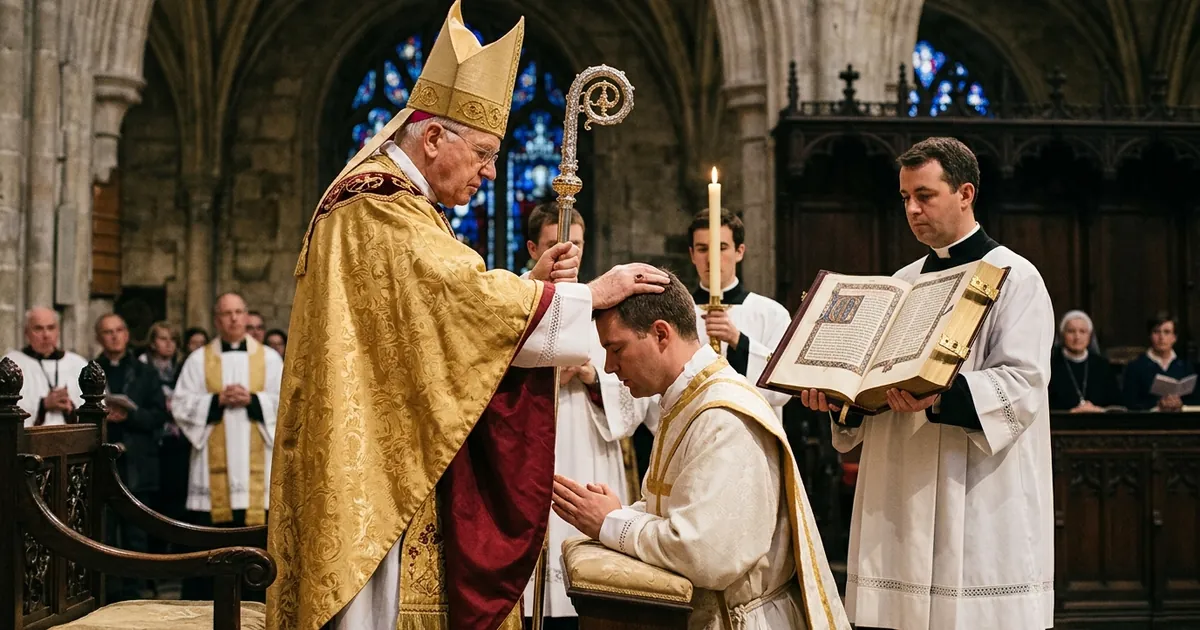
Catholics understand apostolic succession as the continuing transmission of the apostles' mission, teaching responsibility, and sacramental ministry through bishops ordained in historical continuity with them. The New Testament does not use the later phrase “apostolic succession” as a technical label, but it shows apostles appointing leaders, replacing an apostle, entrusting teaching to reliable ministers, and transmitting a gift through the laying on of hands.
Early Christian writers then describe churches led by bishops, presbyters, and deacons and appeal to the public succession of those leaders as a safeguard against invented doctrines. Christians disagree about the precise structure of the New Testament offices and about which communities preserve succession. The Catholic claim is historical and theological, not simply that any person who touches another person's head automatically receives authority.
A prayer for faithful Church leaders
> Lord Jesus, you sent the apostles to teach, sanctify, and shepherd your people. Give bishops, priests, deacons, and all ministers fidelity to your Word, courage to protect the vulnerable, humility to receive correction, and patience to serve. Keep your Church united in truth and make every form of authority a path toward holiness rather than self-importance. Amen.
The precedent of replacing Judas
After Judas dies, Peter cites Scripture and says that another should take his place (Acts 1:15–26). The apostles pray, cast lots, and receive Matthias into the number of the Twelve. The event does not show that every bishop is another apostle in every respect, but it does show that an office connected to the apostolic mission can continue after an individual leaves it.
The number Twelve has a symbolic relationship to the tribes of Israel, and the passage demonstrates an important principle: the apostolic ministry is not treated as a private possession that simply disappears with a vacancy. The Church seeks a successor within prayer, Scripture, and the community.
Timothy and the laying on of hands
Paul reminds Timothy not to neglect the gift given to him when the presbytery laid hands on him (1 Timothy 4:14). In 2 Timothy 1:6, Paul speaks of the gift of God received through the laying on of his hands. The gesture is not merely a handshake or a vote of confidence; it is a visible act of prayer, recognition, and transmission of ministry.
The passages should not be forced into a complete later ordination manual. They do show that early Christian leadership involved a public, embodied act and that authority was connected to a community of ministers rather than only to private inspiration.
Titus and the appointment of elders
Paul leaves Titus in Crete to appoint elders in every town (Titus 1:5). The qualifications that follow include moral character, household responsibility, fidelity to the teaching, and the ability to encourage and correct. In the same discussion, the terms elder and overseer are closely related, although historians continue to discuss how the offices developed in different communities.
The point for apostolic succession is not that a word study alone proves the full Catholic system. It is that the apostles establish a pattern of appointed leaders who receive responsibility to teach, govern, and protect the community after the original missionaries have moved on.
From the apostles to later churches
Paul tells Timothy to entrust what he has heard to faithful people who will be able to teach others (2 Timothy 2:2). The sequence is relational and generational: Paul, Timothy, reliable teachers, and further disciples. The content is not a private secret; it is a public faith handed on.
Other passages show the community choosing and recognizing ministers, praying over them, and holding leaders to moral standards. The Church's continuity therefore involves both doctrine and character. A claim to lineage without fidelity to the Gospel is not enough.
What early Christian witnesses say
Ignatius of Antioch, writing at the beginning of the second century, speaks repeatedly of the bishop, presbyters, and deacons and urges Christians to remain in communion with their bishop. Irenaeus of Lyons later appeals to the succession of bishops in apostolic churches when responding to groups that claimed hidden teachings.
These witnesses do not provide a modern administrative chart. They do show that early Christians considered public continuity of teaching and ordained leadership important. The bishop was not simply a motivational speaker chosen for a single sermon; he belonged to a visible ecclesial order connected to Eucharistic communion and the Church's common faith.
Why succession matters for interpretation
If Christian authority were only a matter of each reader's private interpretation, sincere believers could disagree without a shared way to identify the apostolic faith. Apostolic succession does not remove the need to read Scripture or think carefully. It gives the Church a historical body responsible for guarding the received faith.
This is especially important when new teachers claim a secret message or reinterpret central doctrines in a way unknown to earlier Christian communities. Irenaeus' response was to look at the churches publicly connected to the apostles, not to reward the most persuasive speaker.
Succession is not a guarantee that every bishop is holy or that every institution behaves well. It is a claim about the continuity of office and sacramental ministry. Sinful leaders must still repent and can be disciplined or removed according to Church and civil law.
Apostolic succession and Scripture
Catholicism does not set succession against the Bible. Scripture is the inspired norm within the apostolic deposit. The bishops are servants of that deposit, not authors of a second Gospel. Their authority is exercised in continuity with Scripture, Tradition, the liturgy, and the universal faith of the Church.
This is why the laying on of hands is not magic. The gesture belongs to a prayerful ecclesial act in which the Church recognizes a vocation and entrusts a ministry. A person who claims authority while rejecting the apostolic faith has not proved succession by using the right vocabulary.
Related prayers and guides
Anti-thin-content test
- Clear reason to exist: builds the case from Acts, the Pastoral Epistles, laying on of hands, and early Christian evidence.
- Practical usefulness: explains what succession is, what it is not, and why it matters for interpretation and accountability.
- Distinctive depth: avoids both a proof-text shortcut and an exclusively post-biblical argument.
- Intent satisfied: a reader can understand the Catholic claim while seeing where historical and denominational questions remain.