apologetics / comparative catechesis
Latin Mass vs. Novus Ordo: A Fair Catholic Guide
Compare the Traditional Latin Mass and the Novus Ordo by history, language, readings, gestures, and current norms—without reducing either celebration to a political label.
Part of the Catholic learning prayer collection.
In brief
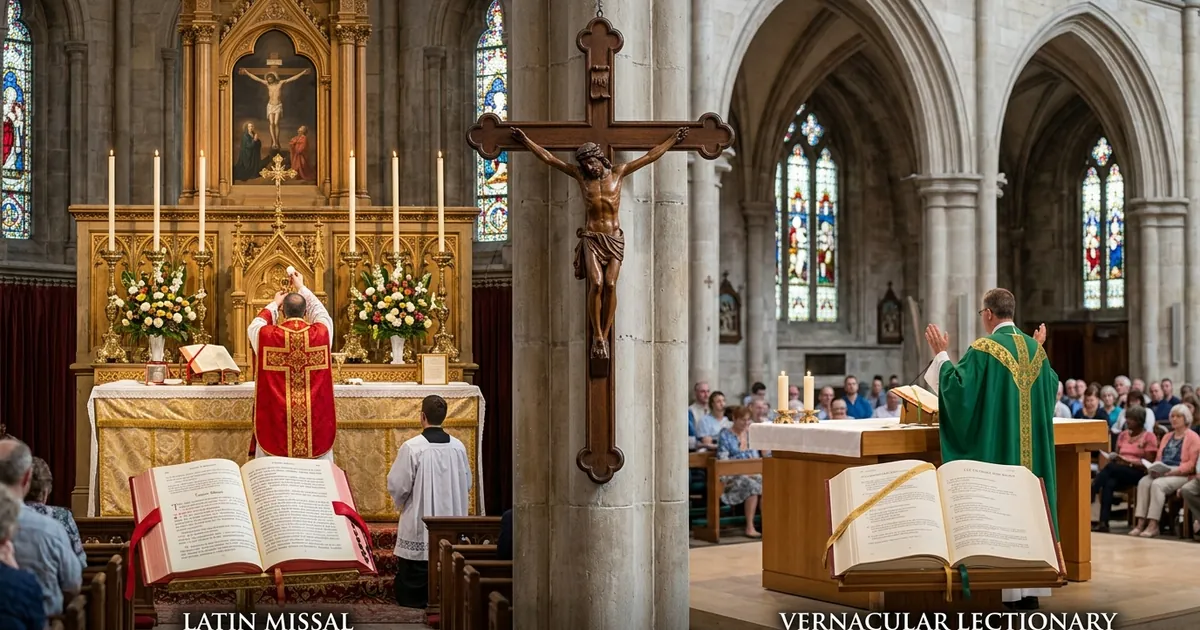
“Latin Mass” and “Novus Ordo” are popular labels that can hide an important distinction. The 1962 Roman Missal, often called the Traditional Latin Mass or TLM, is an older edition of the Roman Missal. The Roman Missal promulgated after the Second Vatican Council, commonly called the Novus Ordo, is the form normally used in parishes today. They share the Catholic faith, the priesthood, the seven sacraments, and the Eucharistic sacrifice, but differ in the missal edition, language options, lectionary, prayers, ceremonial details, and pastoral context.
Neither label should be used as a shortcut for “more Catholic” or “less Catholic.” The celebration available to a person depends on the Church's current universal norms, the bishop's authority, and the concrete arrangements of the local diocese. Because those norms and permissions can change, anyone looking for a specific celebration should consult the diocese or parish rather than rely on an old online summary.
A short historical timeline
- Before the modern missal editions: The Roman Rite developed over centuries. Latin became its principal liturgical language in the West, while prayers, calendars, music, and ceremonial customs matured over time.
- Council of Trent and the 1570 Missal: Following the Reformation era, Pope Pius V promulgated a standardized Roman Missal for broad use, while some older local rites continued under the rules of the time.
- Twentieth-century reforms: The Roman Missal and Holy Week rites underwent revisions before and after the Second Vatican Council. The council called for active participation and permitted a wider use of the vernacular alongside Latin.
- The post-conciliar Roman Missal: Pope Paul VI promulgated a revised Roman Missal in 1969/1970. Its later editions are the basis of the ordinary parish celebration of the Roman Rite.
- Recent regulation: Documents such as Summorum Pontificum (2007) and Traditionis Custodes (2021) changed how the 1962 Missal was regulated. This history should be read with the current official text and diocesan instructions, not with slogans or outdated social-media claims.
Is the Latin Mass banned?
A responsible answer must distinguish “banned everywhere” from “freely available without permission.” The 1962 Missal has not simply disappeared, but its public celebration is governed by current Church law and permissions. The bishop and the Holy See may have responsibilities that affect where and how it is celebrated. Norms have changed over time, and local arrangements may differ.
For a practical answer in your area, contact the diocesan office or a parish and ask which Missal is being used, whether the celebration is authorized, and whether the schedule is current. Do not treat a parish's refusal, a permission requirement, or a change in schedule as proof that another Catholic's faith is invalid.
Main differences at a glance
| Aspect | 1962 Missal / Traditional Latin Mass | Current Roman Missal / Novus Ordo |
|---|---|---|
| Language | The ordinary liturgical language is Latin, with local-language aids or readings according to the celebration. | The vernacular is ordinarily used, while Latin remains possible in the Church's liturgical tradition and norms. |
| Missal and calendar | Uses the 1962 edition and its calendar, subject to current permissions. | Uses the Roman Missal promulgated after the council and its approved calendar. |
| Lectionary | Traditionally follows an older cycle and arrangement of readings. | Uses the post-conciliar lectionary with a broader multi-year cycle in many celebrations. |
| Priest's orientation | Often celebrated ad orientem, with priest and people facing the same direction, though the question is not identical to “Latin versus English.” | Often celebrated facing the people, but orientation is a separate liturgical question and is not defined solely by language. |
| Eucharistic Prayer | The Roman Canon has a prominent and fixed role, with ceremonial and audible patterns characteristic of the 1962 Missal. | Several approved Eucharistic Prayers may be used, with the structure and rubrics of the current Roman Missal. |
| Music | Gregorian chant and sacred polyphony are strongly associated with many celebrations, though music varies. | Chant, polyphony, hymns, and other approved music may be used according to the liturgical norms and parish practice. |
| Participation | Participation may be expressed through silence, chant, responses, a hand missal, and attentive prayer. | Participation commonly includes spoken responses, singing, listening to proclaimed readings, and the same interior offering of prayer. |
This table describes common patterns, not absolute rules for every celebration. A Latin celebration can include vernacular elements, and a Novus Ordo celebration can use Latin or chant. Good catechesis avoids turning a tendency into a definition.
What both celebrations have in common
Both are meant to be worship of the Triune God, not religious theater. Both lead the Church to hear Scripture, offer praise and thanksgiving, pray for the living and the dead, and receive or adore Christ in the Eucharist according to the Church's discipline. Both can be celebrated reverently or poorly; the external form does not automatically guarantee the interior disposition of the ministers or congregation.
The Eucharist is not a different Christ in one celebration and another Christ in the other. Arguments about form should never deny the sacramental reality of a valid Catholic Mass or justify contempt for people who worship according to the Church's approved discipline.
Why people are drawn to each form
People may be drawn to the older celebration because of its silence, sacred music, fixed prayers, Latin, ceremonial continuity, or sense of mystery. Those attractions can lead someone to deeper reverence when they are joined to charity and obedience.
Others value the current Roman Missal because of the vernacular, the wider range of Scripture, audible proclamation, and the ordinary parish life in which families and communities participate. Those gifts can lead to deeper understanding and active prayer when they are joined to reverence and fidelity.
These descriptions are invitations to understand, not promises that a particular form will solve a person's spiritual problems. If a celebration makes someone more patient, truthful, prayerful, and charitable, that fruit matters. If online arguments make someone contemptuous or fearful, step away from the argument and speak with a wise priest or spiritual director.
How to choose a parish responsibly
- Start with the Church's current norms. Ask the diocese or parish which celebration is authorized and when it is offered.
- Attend patiently. A first visit may feel unfamiliar because of language, music, posture, or a different missal. Use an approved hand missal or parish guide.
- Learn what is actually happening. Ask a catechist to explain the readings, Eucharistic Prayer, and local customs rather than relying on hostile videos.
- Look for ecclesial fruit. A sound community should foster worship, sacramental life, charity, family responsibility, and communion with the Catholic Church.
- Do not make preference a test. A Catholic may appreciate Latin, vernacular worship, silence, chant, or a particular parish without declaring other Catholics outside the faith.
St. Joseph and liturgical peace
Saint Joseph's hidden obedience offers a useful spiritual lens for a disputed subject. The Gospels present him as a man who listened, acted, protected his family, and served God's plan without seeking public victory. A Catholic who prefers one liturgical form can imitate that humility: defend what is true without insulting people, obey legitimate pastoral authority, and let worship produce charity in the home.
Related reading
Anti-thin-content test
- Clear reason to exist: it answers the comparative query without forcing the reader into a factional choice.
- Practical utility: the table, timeline, current-norm warning, and parish checklist help a reader make a responsible next step.
- Original depth: it separates language, missal, orientation, lectionary, music, Eucharistic Prayer, and ecclesial authority instead of treating them as one argument.
- Trust boundary: current regulations are not frozen as timeless facts; the page tells readers where to verify local availability.