apologetics / catechesis guide
The Parts of the Catholic Mass: A Clear Guide to Every Section
Understand the four parts of the Catholic Mass, from the Introductory Rites to the dismissal, and discover the meaning of the readings, Eucharistic Prayer, and common gestures.
Part of the Catholic learning prayer collection.
In brief
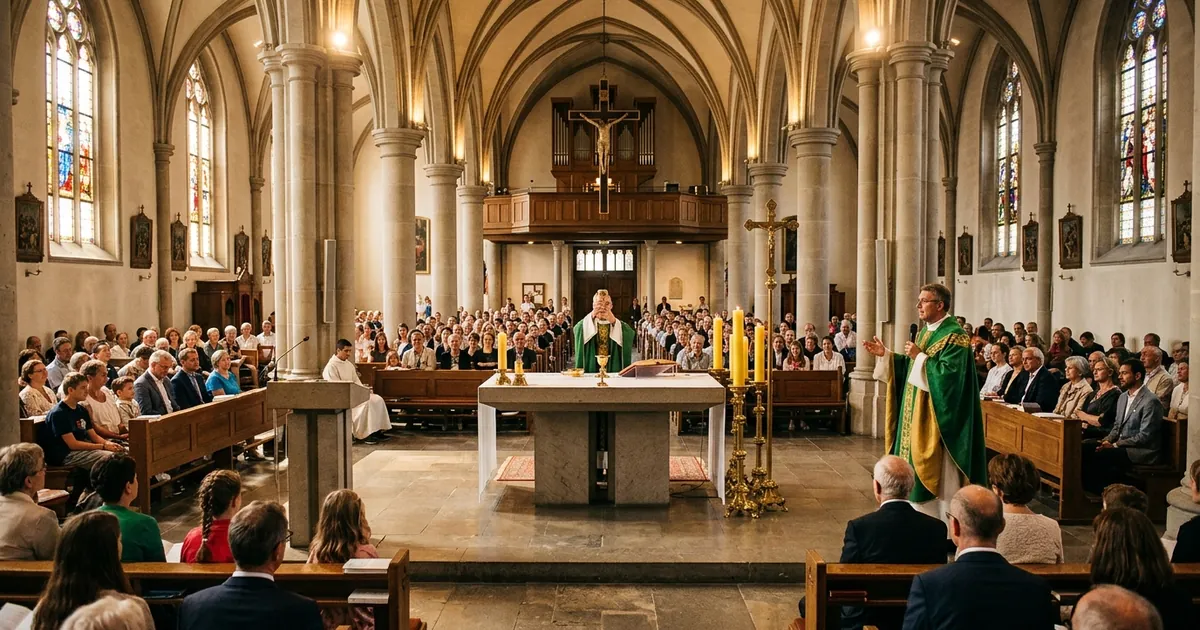
The Catholic Mass has four principal sections: the Introductory Rites, the Liturgy of the Word, the Liturgy of the Eucharist, and the Concluding Rites. Together they gather the Church, proclaim and receive God's Word, offer the Eucharistic Prayer and receive Holy Communion, and send the faithful into the world. The Mass is therefore more than a sequence of speeches: it is the Church's public worship of the Father, through Christ, in the Holy Spirit.
The details can vary by day, season, language, and approved form of the Roman Rite. The outline below is a map for participation, not a replacement for the official missal used at your parish.
1. The Introductory Rites: becoming one worshipping people
The Mass begins before the readings. People arrive from different homes, jobs, worries, and histories, but the liturgy gathers them into one assembly.
- Entrance and greeting: The procession and opening song turn the congregation toward the altar and the celebration. The priest or deacon greets the people, and the people answer.
- Sign of the Cross: We confess that we are gathered in the name of the Father, Son, and Holy Spirit—not around a personality or private spiritual technique.
- Penitential Act: The assembly acknowledges its need for mercy. The act disposes us to hear the Word and worship with humility; it is not the same sacrament as individual Confession.
- Kyrie: “Lord, have mercy” is a prayer of trust in Christ's compassion.
- Gloria: On Sundays outside Advent and Lent, and on solemn celebrations, the Church praises God for his glory and mercy.
- Collect: The priest gathers the prayers of the people into one opening prayer. Listening to the collect is a simple way to notice the theme of the day.
The posture of standing here expresses readiness and common prayer. Local instructions from the celebrant or parish take precedence over a general explanation of posture.
2. The Liturgy of the Word: God speaks to his people
The Liturgy of the Word is not an information block before the “real” part of Mass. Catholics believe Christ is present in his word proclaimed in the liturgy, so the assembly listens, responds, and allows Scripture to shape its life.
The usual Sunday pattern is:
- First reading: normally from the Old Testament, showing God's saving work and the promises that lead toward Christ. During the Easter season it is commonly taken from Acts of the Apostles.
- Responsorial Psalm: the assembly answers God's Word with a psalm, often sung.
- Second reading: usually from an apostolic letter or another New Testament book on Sundays and solemnities.
- Gospel acclamation and Gospel: the people stand to welcome the Gospel, and the minister proclaims the words and actions of Jesus.
- Homily: the ordained minister applies the readings to Christian life. A good homily should help the congregation hear the living Word, not turn the liturgy into a political or personal performance.
- Profession of Faith: on appointed days the assembly responds to God's revelation by confessing the faith together.
- Universal Prayer: the Church intercedes for the Church, the world, people in need, and the local community.
The small crosses made before the Gospel are a local liturgical gesture of readiness: that the Gospel may be in our minds, on our lips, and in our hearts. They are a prayer, not a magical protective sign.
3. The Liturgy of the Eucharist: offering and thanksgiving
The Liturgy of the Eucharist begins with the preparation of the altar and gifts. Bread and wine are brought forward, and the Church also brings the work, needs, relationships, and sacrifices of her people. The gifts are not a payment for grace. They are received into the Church's offering of thanksgiving.
The Eucharistic Prayer
The Eucharistic Prayer is the center and summit of the celebration. The priest presides in the person of Christ, while the whole baptized assembly joins in the prayer. The exact wording depends on the approved Eucharistic Prayer, but its movement commonly includes:
- Preface and Sanctus: thanksgiving leads into the acclamation “Holy, Holy, Holy,” joining earthly worship to the praise of heaven.
- Epiclesis: the Church asks the Holy Spirit to sanctify the gifts.
- Institution narrative and consecration: the priest repeats Christ's words from the Last Supper. Catholic faith confesses that, by the action of Christ and the Holy Spirit, the bread and wine become Christ's Body and Blood.
- Memorial acclamation and anamnesis: the Church proclaims Christ's death and resurrection and presents the one sacrifice of Christ sacramentally.
- Offering and intercessions: the Church offers praise through Christ and prays for the living, the dead, the pope, bishops, and the whole Church.
- Doxology and Great Amen: the prayer reaches its praise of the Father, through the Son, in the Holy Spirit, and the people make the prayer their own with the Amen.
When the congregation kneels during the Eucharistic Prayer, the posture expresses adoration and awe. Timing differs by local norms and approved liturgical practice, so follow the parish's directions without judging another community's posture as a measure of faith.
The Communion Rite
The Lord's Prayer, the sign of peace, the breaking of the bread, and the invitation to Communion prepare the assembly to receive Christ. Catholics who are properly disposed and able to receive according to Church discipline approach Communion reverently; those who do not receive can remain in prayer. A parish may provide local guidance for posture and the manner of receiving.
Holy Communion unites the faithful to Christ and strengthens charity. It is not a private reward for having a perfect week. When a serious sin weighs on the conscience, the Catholic should seek the sacrament of Reconciliation and pastoral guidance before receiving.
4. The Concluding Rites: sent to live the Gospel
The concluding rites are brief but important. The final prayer, blessing, and dismissal send the people back to ordinary responsibilities with a Christian mission. “Go forth” does not mean the prayer is over in the sense that discipleship stops at the church door. It means the worshipping community is sent to practice mercy, truth, justice, and love.
The dismissal also guards against treating Mass as an escape from the world. A parent returns to family life, a worker to a job, a student to school, and a neighbor to the people who need patience and concrete help.
A simple way to participate more deeply
Before Mass, read the Gospel and name one intention. During the readings, listen for one word or image that calls you to conversion. At the offertory, silently place a real concern on the altar. During the Eucharistic Prayer, adore and give thanks rather than trying to control every thought. After Communion, remain quiet long enough to receive the gift. After the dismissal, choose one small act that makes the Gospel visible.
San Joseph offers a fitting model: a worker who received God's word, obeyed without spectacle, protected his family, and made ordinary labor a place of fidelity. That connection is a spiritual application, not a claim that the Gospels give us a detailed description of his daily prayer routine.
Related reading
Anti-thin-content test
- Clear reason to exist: it gives a complete map of Mass and explains why the principal actions matter.
- Practical utility: readers can follow a celebration, prepare beforehand, and choose one concrete practice afterward.
- Original depth: the page connects structure, Scripture, posture, Eucharistic theology, and pastoral application without reproducing the Order of Mass.
- Trust boundary: official liturgical sources are named, local norms are acknowledged, and the page does not pretend to replace a missal, priest, or catechist.