page / catholic apologetics and communion of saints
Is Praying to Saints Biblical? The Catholic Case for Intercession
Does asking saints to pray violate 1 Timothy 2:5? Explore the communion of saints, Revelation 5 and 8, intercession, and Christ's unique mediation.
Part of the Catholic learning prayer collection.
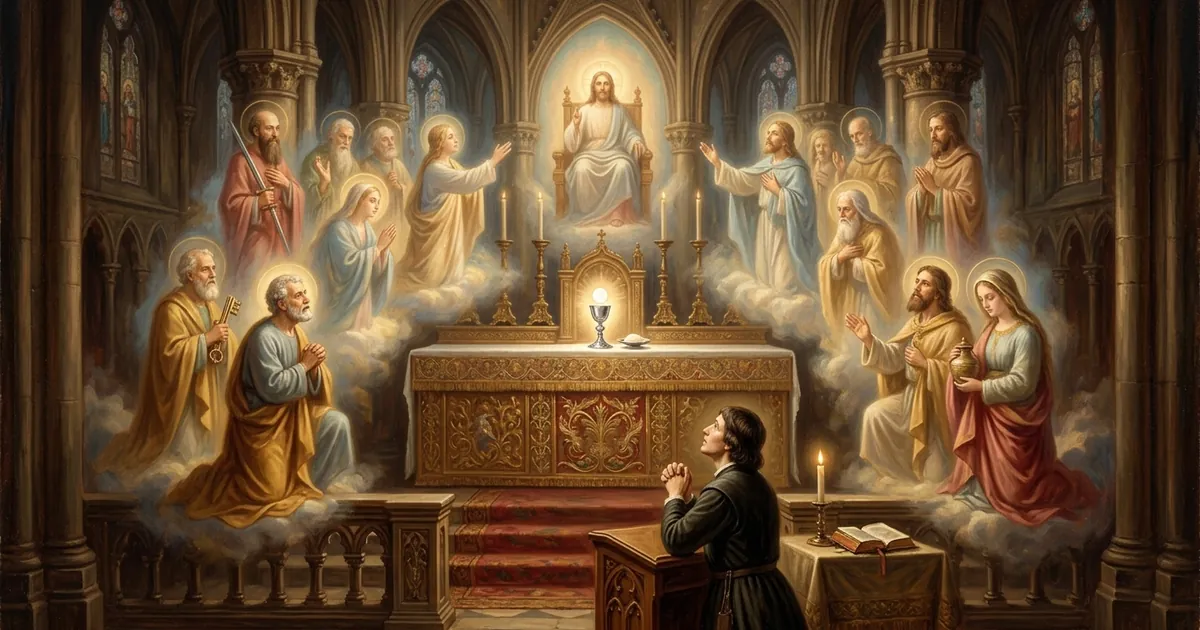
In brief
Catholics who “pray to” saints are asking them to pray with and for the Church, not worshiping them as gods. In older English, “pray” can mean “ask.” The saints remain creatures saved by Christ; they do not replace Jesus, forgive sins by their own power, or receive the adoration owed to God.
The Catholic case rests on the communion of the Church, the Bible's encouragement to intercede for one another, and passages that portray heavenly beings presenting prayers before God. Christians disagree about how directly those passages support asking saints by name. A fair explanation should show the Catholic reading while admitting that Revelation is visionary literature and that the practice depends on a wider theology of life in Christ.
Revelation 5 and 8: prayers before the Lamb
Revelation 5:8 presents the twenty-four elders before the Lamb with golden bowls full of incense, described as the prayers of the saints. Revelation 8:3–4 shows an angel offering incense with the prayers of the saints before God.
Catholic interpreters see these images as evidence that heavenly worship includes the presentation of the prayers of God's people. The passage does not spell out a modern prayer formula such as “Saint N., pray for me,” and “saints” can refer to the faithful on earth. Its value is cumulative: heaven is not portrayed as indifferent, and prayer is shown rising before God through a heavenly liturgy.
A responsible page should avoid saying that Revelation proves every detail of Catholic practice by itself. It supports the broader claim that the members of God's people are united in prayer across heaven and earth.
A simple prayer asking a saint's intercession
> Saint Joseph, faithful servant of Jesus and Mary, pray for me as I bring this need before God. Ask the Lord to give me wisdom, courage, and a heart ready to obey what is good. Keep my prayer centered on Christ, and help me serve my family and neighbor with love. Amen.
“There is one mediator” — 1 Timothy 2:5
First Timothy 2:5 says there is one God and one mediator between God and humanity, the man Christ Jesus. Catholics affirm this without qualification: Jesus alone is the mediator of redemption. His Incarnation, death, and Resurrection reconcile humanity to the Father. No saint adds a second saving sacrifice or competes with Christ.
The question is whether Christ's unique mediation excludes every form of intercession. The surrounding passage asks Christians to make supplications, prayers, intercessions, and thanksgivings for everyone. Saint Paul repeatedly asks other believers to pray for him. If requesting prayer from a Christian on earth does not deny Christ's mediation, Catholics ask why the request would become anti-Christian merely because the Christian is now with God.
Intercession participates in Christ's one mediation; it does not compete with it. A friend who prays for you does not become a second redeemer. The same is true of a saint in heaven, according to Catholic theology.
Are the saints alive or dead?
Jesus says that God is not God of the dead but of the living, because all live to him (Luke 20:38). At the Transfiguration, Moses and Elijah appear and speak with Jesus (Matthew 17:1–8). The martyrs in Revelation cry out to God for justice (Revelation 6:9–11). These passages support the Christian belief that death does not erase the life of the person before God.
Christians interpret the intermediate state differently, and the Bible does not answer every question about how the saints perceive individual requests. Catholics do not claim that saints are omniscient or that they hear prayers by natural power. They believe God can allow the saints to share in Christ's knowledge and intercession.
The communion of saints
The Apostles' Creed's phrase “communion of saints” means more than admiration for heroes. It expresses the unity of the members of Christ's Body: believers on earth, the faithful being purified, and the saints in glory. Prayer is one way this communion becomes active.
Asking a saint to pray is therefore not a request to bypass Jesus. It is a request made within the family of Christ, trusting that the saint's holiness is God's grace. Catholics still pray directly to God the Father, Son, and Holy Spirit. Devotion to a saint is healthiest when it leads to Scripture, the sacraments, mercy, and imitation of Christ.
“Pray for us” rather than “save us”
Catholic prayers ask saints to intercede: pray for us, accompany us, help us imitate Christ, and bring our needs before God. They do not ask saints to create grace, decide who enters heaven, or replace the work of Jesus.
This vocabulary matters. If a devotional text speaks as though a saint has independent control of health, money, fate, or salvation, it needs correction. Saints are powerful intercessors only because God is generous, and the answer to any prayer remains God's free and wise gift.
Related prayers and guides
Anti-thin-content test
- Clear reason to exist: answers the one-mediator objection through intercession, Revelation, the communion of saints, and Christology.
- Practical usefulness: explains language, gives a prayer, and warns against superstition and replacing professional care.
- Distinctive depth: treats Revelation as cumulative evidence rather than an isolated proof-text and distinguishes saintly intercession from redemption.
- Intent satisfied: a reader can understand why Catholics ask saints to pray and where the boundaries are.