page / catholic apologetics and bible study
Is Purgatory in the Bible? The Catholic Biblical Basis Explained
Is Purgatory in the Bible? Explore the Catholic reading of 1 Corinthians 3, Matthew 12, 2 Maccabees, prayer for the dead, and why Purgatory is not a second chance.
Part of the Catholic learning prayer collection.
In brief
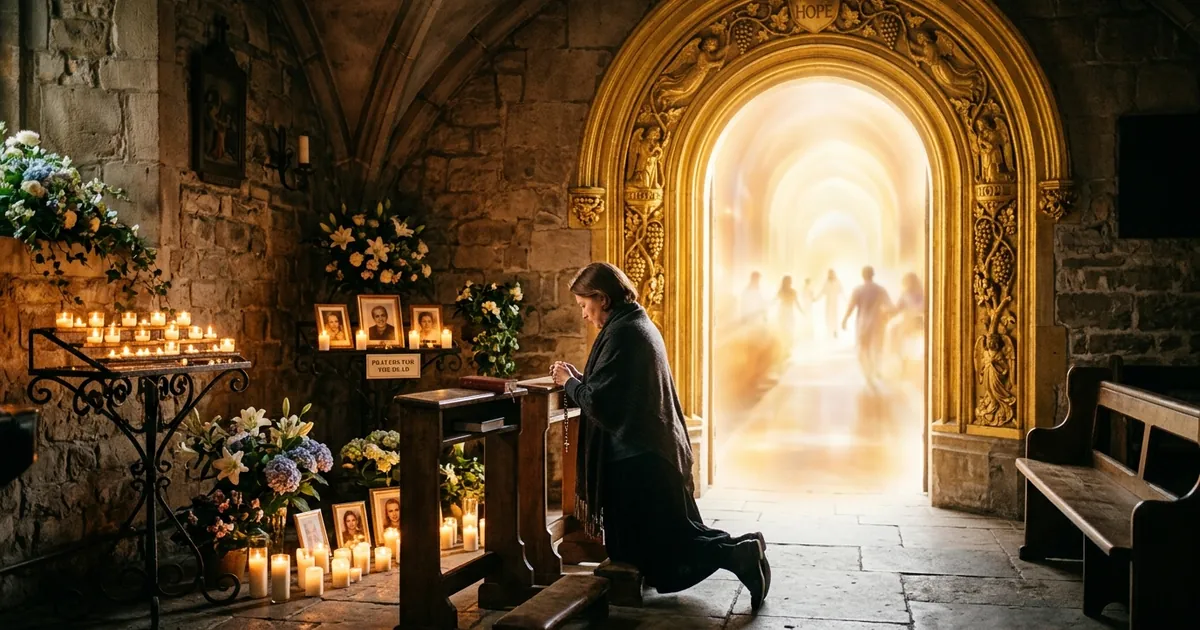
The word “Purgatory” is not found in most English translations of the Bible, but Catholics believe the reality it names is taught by Scripture and developed in the Church's apostolic tradition. Purgatory is the final purification of people who die in God's friendship but still need healing from the effects of sin. It is not a third eternal destination, a way to purchase salvation, or a second chance to choose God after death.
Catholic reasoning normally uses several strands together: the call to holiness, biblical images of purification, the possibility of forgiveness or accountability beyond this age, the practice of praying for the dead, and the witness of early Christian worship. The case is cumulative. A reader should compare the passages in context and recognize that Christians who share the Bible do not all interpret them in the same way.
2 Maccabees 12:38–46 and prayer for the dead
After a battle, Judas Maccabeus and his companions discover that some fallen soldiers had acted against the law. Judas takes up a collection for a sin offering and the text praises prayer and sacrifice for the dead. The passage concludes that it is holy and wholesome to pray for the dead so that they may be loosed from sin.
Catholics receive 2 Maccabees as part of the Old Testament. Many Protestants and Jews do not include it in their biblical canon, so it cannot by itself persuade someone who rejects its authority. It remains important for two reasons: it is a direct witness to Jewish belief in intercession for the dead before the time of Christ, and it shows that the practice was not invented in the medieval period.
A respectful conversation should not say that rejecting 2 Maccabees settles the issue. Instead, ask what other passages and historical evidence show about forgiveness, purification, resurrection, and prayer for the departed.
A simple prayer for the departed
> Merciful Father, through Jesus Christ your Son, receive the souls of those who have died in faith. Purify what remains wounded, forgive every sin, and bring them into the fullness of your peace. Teach us to hope in your mercy, to pray with love, and to live ready for the day when every tear is wiped away. Amen.
What Catholics mean by Purgatory
The Catechism describes Purgatory as a final purification for the elect, different from the punishment of the condemned. A person in Purgatory is already saved and will reach heaven. The purification is not a negotiated sentence or a temporary version of hell; it is the completion of holiness needed for full communion with God.
This distinction answers two common misunderstandings:
- Not a second chance: Catholic teaching does not say that someone who definitively rejects God at death receives another opportunity to reverse that choice.
- Not salvation by works: grace saves. Purification does not compete with Christ's saving work; it describes what grace does in a person who is saved but not yet perfectly healed.
The Church does not define a physical location, a timetable, or a scientific process for Purgatory. Images of fire, debt, washing, and passage are biblical and theological images, not a permission to invent detailed maps of the afterlife.
The argument from holiness and unfinished conversion
Catholics begin with two biblical convictions. First, God's presence is completely holy: Revelation 21:27 says that nothing unclean enters the heavenly Jerusalem. Second, many believers die trusting God while still carrying disordered habits, wounds, and attachments that have not been fully transformed.
The Catholic conclusion is that God can finish this purification after death for those who belong to him. This is an argument from the coherence of the biblical picture, not a verse that functions like a dictionary definition. Protestants may answer that Christ's righteousness covers the believer immediately or that the passages mean something else. A useful apologetic presentation should state the Catholic inference honestly rather than calling disagreement irrational.
1 Corinthians 3:11–15: saved through fire
Paul writes about the foundation of Jesus Christ and the testing of each person's work. Some work endures like gold, silver, or precious stones; some is burned up. The person whose work is lost suffers loss, yet “he himself will be saved, but only as through fire.”
Catholic readers see a strong image of purification: the person is saved, but what is false or worthless cannot remain. The passage may also be read as a judgment of a person's ministry rather than a detailed description of the afterlife. That is why it is best presented with the wider case, not as a stand-alone proof that settles every debate.
The text supports an important principle either way: salvation does not make holiness irrelevant. God tests and purifies what a person has built on Christ.
Matthew 12:32: forgiveness in the age to come
Jesus says that blasphemy against the Holy Spirit will not be forgiven “either in this age or in the age to come.” Catholic interpreters have understood the wording to leave open the possibility that some sins can be forgiven in the age to come, while the specific sin Jesus names cannot.
This is an indirect argument. The verse warns about the gravity of hardened rejection; it does not use the word Purgatory. It becomes more significant when read beside the Christian practice of intercession for the dead and the belief that God's sanctifying work is not defeated by death.
Matthew 5:25–26: paying the last penny
In the Sermon on the Mount, Jesus uses the image of a debtor being handed over until the debt is paid. Some early Christian writers and Catholic interpreters have seen a picture of temporal consequences and purification. Others read the passage as a warning about reconciliation before judgment.
The application should therefore be described as a traditional interpretation, not as the only possible meaning. It still helps explain why Catholic theology distinguishes eternal forgiveness from the healing and consequences that remain after a person has turned back to God.
Praying for the dead in Christian tradition
The earliest Christians remembered the dead by name in liturgy and asked God to grant them rest. Inscriptions, prayers, and the writings of early pastors show that intercession for the departed was part of Christian life. This practice makes sense if the dead can still benefit from God's mercy and if the Church remains united across death.
Prayer does not inform God of something he does not know or force him to change an eternal verdict. It expresses love and communion. Catholics may offer a Mass intention, pray a Psalm, recite a decade of the Rosary, or speak simply to God for a deceased person. The page Prayers for the Departed can provide a devotional starting point.
Is Purgatory a punishment?
Purgatory includes purification that may be painful because sin and attachment are painful to surrender. Yet the person there is not abandoned or uncertain about the final destination. The deepest reality is hope: God completes the work of sanctification.
The Church does not give readers permission to calculate how long a particular soul remains in Purgatory or to claim knowledge about a deceased person's state. Avoid spiritual content that promises a precise number of days, treats prayer as a transaction, or exploits grieving families. Indulgences are governed by current Church norms and should be learned from an authoritative diocesan or Vatican source, not from a formula on a social-media graphic.
Related prayers and guides
Anti-thin-content test
- Clear reason to exist: gives a balanced Catholic explanation of Purgatory, its biblical arguments, tradition, and boundaries.
- Practical usefulness: provides a way to pray for the departed and answers the second-chance, grace, canon, and hell objections.
- Distinctive depth: presents the cumulative case while acknowledging interpretive differences instead of relying on one proof text.
- Intent satisfied: a reader can understand what Catholics mean, examine the passages, and continue the conversation respectfully.