page / catholic apologetics and comparative bible study
Is Sola Scriptura Biblical? Scripture, Tradition, and the Canon
Does the Bible teach Sola Scriptura? Examine 2 Timothy 3:16, apostolic Tradition, the canon of Scripture, and the Catholic model of authority.
Part of the Catholic learning prayer collection.
In brief
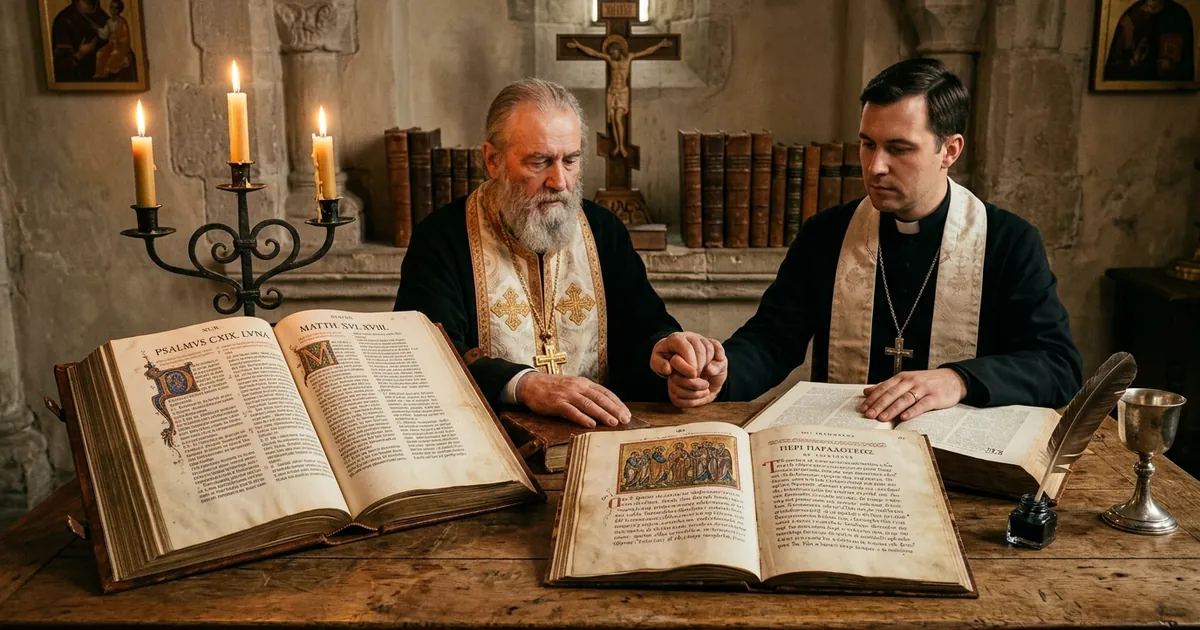
The Bible teaches that Scripture is inspired, authoritative, and profitable for teaching, correction, and formation. It does not contain the phrase “Scripture alone” or a complete table of contents identifying which writings belong in the New Testament. Catholics therefore reject Sola Scriptura when it means that Scripture is the only infallible rule and that Christian doctrine must be derived from the Bible apart from apostolic Tradition and the Church's teaching office.
This is not an argument against the Bible. Catholics place Scripture at the center of Christian faith. The question is how Christ intended the apostolic deposit to be transmitted and authentically interpreted. Catholic theology describes a unity of Sacred Scripture, Sacred Tradition, and the Magisterium, with Scripture inspired by God and the other two serving its faithful transmission and interpretation.
A prayer for understanding Scripture
> Holy Spirit, teach me to receive Sacred Scripture with reverence, humility, and a willing heart. Keep me faithful to the apostolic faith, protect me from pride in my own interpretation, and help me recognize the truth handed on in the Church. Let my study lead to obedience, charity, and a deeper love for Jesus Christ. Amen.
What Sola Scriptura means
Definitions vary. Some Christians use “Sola Scriptura” to mean that Scripture is the final norm by which every tradition is tested. Others mean that Scripture is the only infallible authority and that no Church office can bind the conscience with a teaching not explicitly stated in the text.
This page addresses the stronger, classical claim: Scripture alone is the sole infallible rule of faith, independent of binding apostolic Tradition and a visible teaching office. Catholics agree that traditions can be corrupt and that every teaching must be measured against the apostolic faith. They disagree that a private reader or an invisible consensus is the only alternative to corruption.
Does 2 Timothy 3:16–17 teach “Scripture alone”?
Paul writes that all Scripture is inspired by God and useful for teaching, correction, and training in righteousness, so that the person of God may be complete and equipped for every good work. Catholics fully affirm this.
The passage says what Scripture is and what it does. It does not add the word “alone.” “All Scripture is inspired” is not the same grammatical claim as “only Scripture is an infallible authority.” A statement that all Scripture is profitable does not deny that God also teaches through apostolic preaching, sacramental life, and the Church's received faith.
There is also a historical question. When Paul wrote to Timothy, the New Testament was not yet a closed collection in the form Christians hold today. “Scripture” primarily referred to the sacred writings of Israel, while the apostolic message was transmitted through preaching, letters, worship, and the life of the Christian communities. The verse cannot by itself be a direct definition of a later doctrine about the complete New Testament canon.
The New Testament teaches written and spoken Tradition
In 2 Thessalonians 2:15, Paul tells believers to stand firm and hold to the traditions they were taught “by word of mouth or by letter.” The contrast is not between a good written tradition and a bad oral one; both forms are included in the apostolic instruction.
Paul makes a similar appeal in 1 Corinthians 11:2, praising the community for maintaining the traditions he delivered. In 2 Timothy 2:2, Timothy is told to entrust what he has heard to faithful people who can teach others. John ends a letter by saying he has more to write but prefers to speak face-to-face (3 John 13–14).
These passages do not mean that every later custom has apostolic authority. Catholic Sacred Tradition means the living transmission of the apostolic faith, not any practice that happens to be old. The Church must distinguish the deposit of faith from local habits, theological opinions, and cultural forms.
The canon problem: who supplied the table of contents?
A Bible does not contain an inspired table of contents within its own pages. A reader needs a historical community to identify which books are apostolic, which writings are orthodox, and which texts should be read in the Church's liturgy. Early Christians debated some books, recognized others gradually, and used the rule of faith received from the apostles.
Regional councils at Rome, Hippo, and Carthage are important evidence of the Church's early recognition of the New Testament collection. They did not manufacture divine inspiration; they bore witness to the canon received in the life of the Church. Different Christian traditions later received different Old Testament collections, which makes the authority question even more visible.
The Catholic argument is not that a council's date magically solves every historical question. It is that the closed canon is known through the Church's historical reception and apostolic Tradition. If someone says, “I accept only the books that the Bible itself authorizes,” the Bible cannot supply that list without importing a rule from outside the Bible.
This is a logical dependence, not an insult. A Christian may believe that the Holy Spirit guided the Church's recognition of the canon without believing that every later Church decision is protected from error.
Scripture, Tradition, and the Magisterium
The Catholic model is sometimes illustrated as a three-legged stool, although the image is only an analogy. Sacred Scripture is the inspired written Word of God. Sacred Tradition is the living handing-on of the apostolic faith. The Magisterium is the teaching office entrusted with authentically interpreting the Word of God in Scripture and Tradition.
The Magisterium is not above God's Word. It serves it. Nor is Tradition a second revelation that can contradict Scripture. The three are connected because they arise from the one apostolic deposit. The Church's authority is exercised through bishops in communion with the successor of Peter, within the limits and purposes defined by Catholic doctrine.
This model answers two opposite dangers:
- Bible without the Church: private interpretation can fragment communities and cannot explain how the canon was received.
- Church without the Bible: institutional power can drift from apostolic teaching and must be corrected by the Word it serves.
Is Sola Scriptura self-refuting?
The phrase “self-refuting” can be useful but should be used carefully. The challenge is this: if Sola Scriptura is a binding, infallible rule, where does Scripture teach that only Scripture can bind Christians infallibly? If the answer is not found in Scripture, then the doctrine relies on a theological inference or a tradition about Scripture's role.
That does not prove that every Protestant Bible reader has no authority or that every Catholic interpretation is automatically correct. It shows that “Scripture alone” is not a neutral reading without assumptions. All communities rely on some account of canon, interpretation, language, history, and the Spirit's guidance. Catholicism makes those sources visible rather than treating one interpretive framework as if it had no history.
A respectful way to discuss authority
A good conversation should begin with shared convictions: Scripture is inspired; Jesus is Lord; the apostles were entrusted with teaching; false traditions must be rejected; and Christians need truth rather than personal preference. Then ask:
- What does “alone” add to the biblical teaching about Scripture?
- How was the New Testament canon identified?
- What happened when sincere readers reached incompatible interpretations?
- How does the community preserve apostolic teaching across generations?
- Which traditions are merely human customs, and which belong to the apostolic deposit?
The goal is not to win an argument by exhausting a friend. It is to seek the truth with patience, accurate citations, and charity. Catholic apologetics should make the beauty and coherence of the faith visible, not turn a person into an opponent to defeat.
Related prayers and guides
Anti-thin-content test
- Clear reason to exist: explains the authority debate through Scripture, oral apostolic teaching, canon history, and the Catholic model.
- Practical usefulness: provides conversation questions, a prayer, and answers to the most common proof-text objections.
- Distinctive depth: treats the canon and interpretation problem without using an aggressive “gotcha” tone.
- Intent satisfied: a reader can distinguish biblical authority from the theory that Scripture must operate alone.