page / catholic apologetics and devotional theology
Why Do Catholics Have Statues? Idolatry, Veneration, and the Bible
Do Catholic statues violate the Second Commandment? Explore Exodus 20, the cherubim, the bronze serpent, the Incarnation, and the difference between worship and veneration.
Part of the Catholic learning prayer collection.
In brief
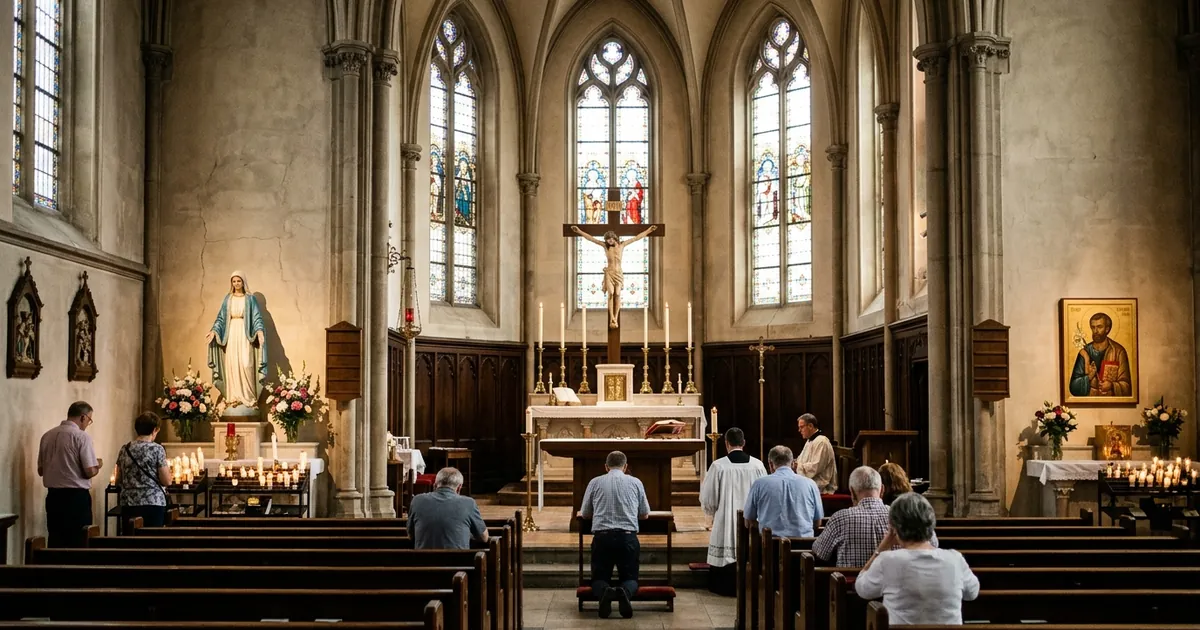
Catholics do not worship statues. They use images to honor Christ, remember the saints, teach the faith, and direct prayer toward the person represented. The Bible forbids making or serving images as gods, but it does not forbid every religious image. In fact, God commanded Israel to make certain sacred images, including the cherubim over the Ark and the bronze serpent in the wilderness.
The Catholic distinction is simple but important: adoration belongs to God alone; honor given to a saint is not worship of the saint or the material object. A statue has no divine power by itself. If a devotional object becomes a substitute for God, a superstition, or a source of manipulation, the practice has crossed into the problem Scripture condemns.
A prayer before a sacred image
> Lord Jesus, through every true image of your life and your saints, turn my heart toward you. Keep me from superstition and from honoring created things as gods. Teach me to remember the faithful, imitate their charity, and give you alone the worship that belongs to you. Amen.
What the Second Commandment forbids
Exodus 20:4–5 warns Israel not to make an image in order to bow down to it and serve it as a god. The command belongs to Israel's covenant struggle against idolatry: worshiping the creature instead of the Creator, trusting an object to control divine power, or treating a created form as a god.
The command must be read with the whole Torah. If the mere existence of a carved or painted image were always sinful, the later instructions for the Tabernacle and Temple would contradict the command. The biblical issue is not whether matter can be shaped into art; it is whether a person gives divine worship to a created thing.
God commanded images on the Ark
In Exodus 25:18–20, God instructs Moses to make two cherubim of gold and place them on the mercy seat of the Ark. These are three-dimensional representations of heavenly beings in the most sacred place of Israel's worship.
The cherubim were not gods and were not offered sacrifices as gods. They signified the heavenly throne and the presence of the Lord. Their existence shows that religious imagery is not intrinsically forbidden. Its meaning and use matter.
The bronze serpent
In Numbers 21:8–9, God tells Moses to make a bronze serpent and lift it up. The Israelites who look at it are healed. Jesus later uses the lifted serpent as an image of his saving mission (John 3:14–15).
The same object later becomes a danger. When people begin burning incense to it as though it were divine, King Hezekiah destroys it (2 Kings 18:4). This passage gives Catholics a necessary correction: an object may begin as a legitimate reminder and still become an idol if devotion is redirected toward the object itself.
Images in Solomon's Temple
First Kings 6 describes carved cherubim, palm trees, flowers, and other ornament in the Temple. The biblical account does not treat all sacred art as a violation of the commandment. The Temple's images pointed beyond themselves toward the glory and order of God's creation.
The example does not mean that every artistic choice in every church is spiritually helpful. It means the argument “the Bible forbids every religious image” cannot fit all of the biblical evidence.
Latria, dulia, and hyperdulia
Catholic theology uses technical words to distinguish forms of honor:
- Latria: adoration and sacrifice owed to God alone—the Father, Son, and Holy Spirit.
- Dulia: honor shown to angels and saints as creatures who belong to God and witness to his grace.
- Hyperdulia: a unique, higher form of honor given to Mary because of her role as the Mother of God; it remains infinitely different from divine worship.
These terms describe the object and kind of honor, not a magic defense for any action someone chooses to perform near a statue. A person can misuse a devotional practice. The test is whether the heart and act recognize God as the source of salvation and the saint as a creature who points to him.
Why kneel or light a candle?
Body language communicates meaning. Kneeling before a statue may be an act of prayer to God in the presence of an image, or a request for the saint's intercession. Lighting a candle can symbolize the prayer being offered and Christ's light. Neither act gives the material object a mind, a will, or a divine power.
The same principle applies to a family photograph. Someone may kiss a photograph of a deceased parent, not because paper is the parent, but because affection reaches through the image to the person remembered. The analogy is limited—saints are not merely memories—but it helps explain why physical gestures do not automatically equal worship.
The Incarnation changes the question
Before the Incarnation, Israel was warned against making an image of the invisible God as though a creature could contain him. In Jesus Christ, the Word became flesh and the Son was seen, heard, touched, and portrayed. The Christian image of Christ is therefore a confession that the Incarnation is real.
Saint John of Damascus defended sacred images by arguing that Christians do not worship matter as matter; they honor the God who entered material creation. This does not turn every painting into a sacrament or require a particular artistic style. It explains why the Church can use matter to teach and remember the visible life of Jesus.
When a statue becomes an idol
A statue becomes spiritually dangerous when a person:
- treats it as a god or source of supernatural power apart from God;
- believes a particular object guarantees money, healing, protection, or success;
- obeys a seller or influencer who exploits fear around the object;
- gives a saint the worship, sacrifice, or absolute trust due only to God;
- ignores the moral demands of the Gospel while performing devotional gestures.
Catholic devotion must always return to conversion, charity, the sacraments, and trust in God. The Church can correct or remove practices that become superstitious or abusive.
Related prayers and guides
Anti-thin-content test
- Clear reason to exist: explains the biblical, theological, and practical distinction between sacred images and idolatry.
- Practical usefulness: gives positive Bible examples, defines the Catholic terms, and lists signs of superstition.
- Distinctive depth: includes the bronze serpent's later misuse and the Incarnation rather than treating statues as decoration only.
- Intent satisfied: a reader can understand why Catholics use images and where the boundary of idolatry lies.