apologetics / catechesis guide
Why Catholics Use Incense, Holy Water, and Candles
Discover the biblical and Catholic meaning of incense, holy water, and candles—and why sacramentals are signs of faith, not magical objects.
Part of the Catholic learning prayer collection.
In brief
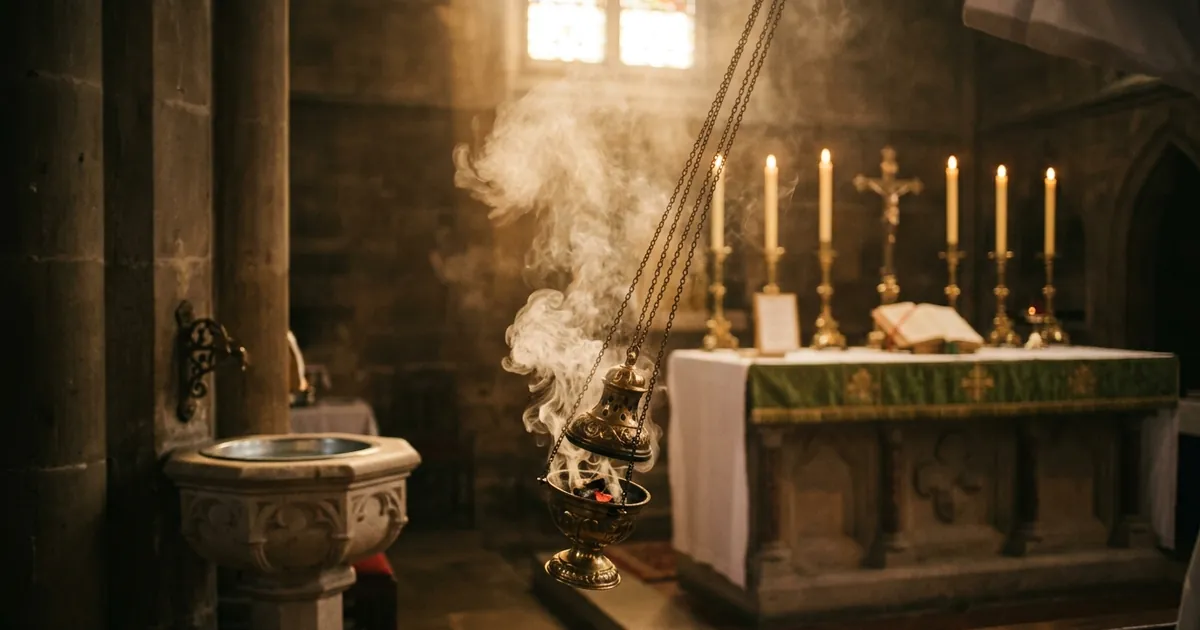
Catholics use incense, holy water, and candles as sacramentals and liturgical signs. They engage the senses and point the worshipper toward God: incense can represent prayer rising to heaven, water recalls Baptism, and light points to Christ. Catholics do not worship the smoke, water, wax, or flame, and these objects do not work as charms. Their meaning comes from the Church's prayer, Scripture, and the faith with which a person uses them.
The Incarnation is important here. Christians believe that the Son of God truly took flesh, so material things can serve worship without becoming gods. A sacramental does not replace the sacraments, the moral life, medical care, or practical responsibility. It helps a person turn ordinary life toward grace.
Incense: a sign of prayer and honor
Incense appears in the worship of Israel. The Old Testament describes an altar of incense and the offering of fragrant smoke in the sanctuary (Exodus 30:1–10). Psalm 141:2 connects incense with prayer: “Let my prayer be counted as incense before you.” In the New Testament vision of Revelation, incense is associated with the prayers of the saints before God (Revelation 5:8; 8:3–4).
At Mass, incense may be used to honor the altar, the Gospel book, the gifts, the minister, and the people. It can communicate several truths at once:
- prayer rises to God;
- the liturgical action is holy and deserves reverence;
- the people gathered for worship are not disposable or anonymous;
- the earthly liturgy participates in the worship of heaven.
The smoke is not a spiritual force that forces God to answer. A person may pray without incense, and someone with asthma, migraine, pregnancy-related sensitivity, or another health concern should move away or ask the parish about alternatives. Reverence never requires avoidable harm.
A simple prayer with a sacramental
You can pray without any object. If holy water or a candle helps you focus, begin with the Sign of the Cross and say in your own words:
> God of mercy, thank you for the gift of Baptism and for the light of Christ. Receive the prayers I bring today, purify my intentions, and teach me to serve my family and neighbors with patience. May this sign turn my heart toward you, not toward fear or superstition. Through Christ our Lord. Amen.
If the intention concerns illness, danger, abuse, debt, or a serious family crisis, add a concrete step: call a doctor, contact emergency services, ask a trusted person for help, speak with a pastor, or make a practical plan. Prayer and responsible action belong together.
Holy water: remembering Baptism
When Catholics make the Sign of the Cross with holy water, the water points back to Baptism and the Christian calling to live in Christ. It is not a way to wash away sin in the sacramental sense; mortal sins are forgiven through the Sacrament of Reconciliation when a person is properly disposed. Holy water is a reminder and a prayerful sign.
Families may keep holy water from a parish in a safe, clean container and use it when entering or leaving the home, beginning prayer, or recalling a baptismal promise. The water does not make a person immune from suffering, accidents, temptation, or illness. It should never be used to delay a smoke alarm repair, medical appointment, safeguarding report, or other necessary action.
Candles: light, presence, and self-giving
The flame of a candle can recall Christ's words, “I am the light of the world” (John 8:12), and the Paschal Candle is a prominent sign during the Easter season and Christian initiation. A votive candle can also represent a prayer entrusted to God, especially when the person has left the church but continues to remember the intention.
The image is not that wax buys an answer. A candle consumes itself while giving light, so it can become a modest symbol of love, sacrifice, and attention. Catholics may light a candle while praying for the sick, the dead, a family decision, or peace, while leaving the result in God's hands.
Always use candles safely. Keep them away from curtains, children, pets, paper, and unstable surfaces; never leave a burning candle unattended. Battery-operated candles are an entirely appropriate alternative in a home where open flame is unsafe.
Sacramentals are not magic
Magic, in the problematic sense, tries to control an outcome through a technique, formula, or object. Catholic sacramentals do the opposite: they direct a person toward God and the Church's prayer. They do not manipulate God, guarantee a result, or excuse a person from repentance and charity.
This distinction matters in practice. It is not Catholic faith to say that a particular amount of holy water will certainly prevent an accident, that incense will drive away every problem, or that a candle guarantees a requested favor. Such claims can create fear, financial exploitation, and spiritual confusion. A priest, deacon, catechist, or parish can explain the approved use of a sacramental.
Why this matters at Mass
The Church's worship uses the body as well as the mind. We stand, kneel, bow, sing, hear, see, and sometimes smell incense. These actions do not make worship theatrical; they help embodied human beings receive and express the meaning of the liturgy. They also teach children and newcomers that Christian faith is not only an idea held privately.
The signs must remain signs. If a parish uses incense, the ministers should use it according to the liturgical books and care for the health of the congregation. If a church provides holy water, it should be maintained hygienically. If candles are offered, fire safety matters. Good worship respects both reverence and people.
Related reading
Anti-thin-content test
- Clear reason to exist: it answers why Catholics use three visible sacramentals and addresses the superstition objection directly.
- Practical utility: it gives safe, ordinary ways to pray and explains when an object should not be treated as a solution.
- Original depth: biblical symbolism, liturgical use, home practice, safety, and sacramental theology are integrated into one readable explanation.
- Trust boundary: no guaranteed protection, financial pressure, or replacement of sacraments and professional care.