liturgical-year / family guide
The Advent Wreath: How to Pray with It at Home
Learn the meaning of the Advent wreath, how to light it safely each week, and a simple Catholic prayer for families preparing for Christmas.
Part of the Liturgical Year prayer collection.
In brief
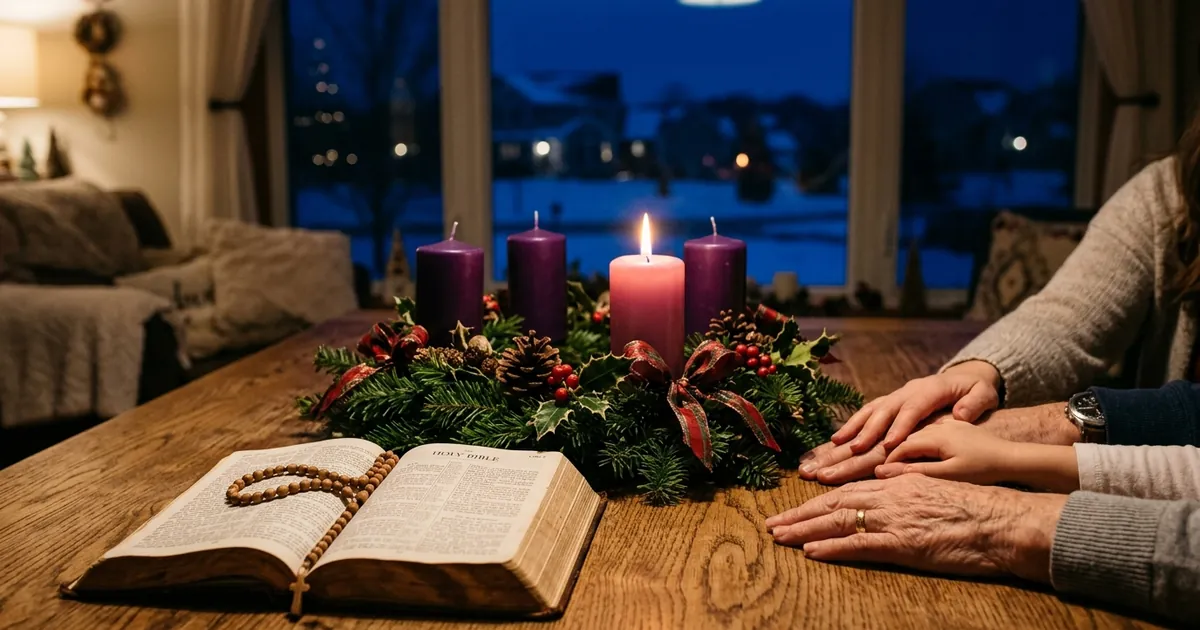
An Advent wreath is a circular arrangement of evergreen branches and four candles used by many Christian families to mark the Sundays of Advent. Each week, another candle is lit as the household prays and remembers God's promises fulfilled in Jesus Christ. The wreath is a visual aid, not a sacrament and not a magical object. A family may ask God to bless its use at home; a priest or deacon can lead the Church's formal blessing according to the approved rite.
The exact colors, candle themes, and customs vary. In many Catholic parishes there are three violet or purple candles and one rose candle, with a white Christ candle sometimes added for Christmas. Some families use different colors. The meaning is carried by prayer and the season, not by a color formula that guarantees spiritual results.
A simple home prayer
On the first Sunday of Advent, gather around the unlit wreath. Make the Sign of the Cross, read a short Scripture passage, and pray:
> God of promise, as we begin Advent, teach us to wait with hope and to prepare our hearts for Jesus Christ. Bless the prayer we offer around this wreath. May its growing light remind us to practice truth, mercy, and patience. Keep our home safe and make it a place where your love is shared. Through Christ our Lord. Amen.
Then light the appropriate candle. A lay family is asking God for blessing through its prayer; it is not claiming to perform the Church's formal liturgical blessing. If a parish provides an official household rite, follow that text.
What the wreath can teach
- The circle: a shape without a beginning or end can remind a family of God's faithfulness and the hope of eternal life. It is a symbol, not a proof that God is physically present in the wreath.
- Evergreens: living greenery can evoke life and hope during the dark part of the year. Families with allergies or safety concerns may use a non-flammable artificial wreath.
- Growing light: as more candles are lit, the household remembers the approach of Christmas and Christ's light.
- The season of waiting: Advent looks toward Christ's birth, celebrates his presence, and awaits his final coming. It is not simply a countdown to gifts.
Popular guides often assign hope, peace, joy, and love to the four candles. Those themes can be helpful for family prayer, but they are not a universal official naming system that every Catholic must follow. You can use them or choose a Scripture theme for each week.
A Scripture-based weekly rhythm
Use the Sunday readings from your parish or a reliable lectionary resource. If you want a simple sequence, the family can pray:
- Week 1: hope in God's promise; read a short passage from Isaiah or the Psalms.
- Week 2: preparation and repentance; read the call to prepare the way of the Lord.
- Week 3: joy in God's nearness; notice the rose candle and the invitation to rejoice.
- Week 4: love and readiness; pray with the Annunciation or another Gospel passage appointed by the calendar.
- Christmas: light a white candle if your family uses one and proclaim the Gospel of Christ's birth.
This sequence is a family framework, not a replacement for the readings actually appointed for the day.
How to prepare the wreath
- Place the wreath on a stable, heat-resistant surface away from curtains, books, paper, pets, and children's reach.
- Check that the candle holders are secure and that the wreath cannot tip.
- Keep a way to extinguish the candles nearby; never use water on a hot wax fire unless a fire-safety professional directs it.
- Choose one person to light and extinguish the candles, or assign an adult to supervise closely.
- Decide on a short prayer and Scripture passage that the family can repeat peacefully.
Battery-operated candles are a good choice for young children, nursing homes, classrooms, households with pets, or anyone who cannot safely use an open flame. Safety is part of responsible stewardship, not a lack of devotion.
A five-minute weekly routine
- Turn off distracting screens and gather safely.
- Make the Sign of the Cross.
- Light the candles already appointed for that week.
- Read the Sunday Gospel or one short Advent verse.
- Name one hope and one person who needs prayer.
- Pray the Our Father or the original prayer above.
- Extinguish the candles completely before anyone leaves the room.
Families can add a hymn, a decade of the Rosary, the Angelus, or a work of mercy. Keep the routine short enough that children can participate without learning to resent it.
Saint Joseph and active waiting
Saint Joseph offers a useful Advent example because the Gospel presents him receiving God's direction, protecting Mary and the child Jesus, and acting faithfully in uncertain circumstances. Scripture does not call him “the patron saint of Advent waiting” as an official universal title, so that phrase should be understood as a devotional application.
A family can imitate Joseph's active waiting by preparing a safe home, helping someone who is carrying a burden, keeping a promise, or choosing quiet service over frantic consumption. The wreath is valuable when it leads to this kind of life beyond the table.
When should the wreath be blessed?
A parish may bless Advent wreaths during Mass or provide a household prayer for the first Sunday of Advent. A family can also begin its own prayer at home without waiting for a formal ceremony. If a priest or deacon is available, ask the parish which approved rite is used. Do not buy an object advertised as spiritually powerful because it has been “specially blessed.”
Related reading
Anti-thin-content test
- Clear reason to exist: it answers both “what does the wreath mean?” and “how do we pray with it safely?”
- Practical utility: setup, weekly routine, prayer, accessibility, and formal-blessing boundaries are explicit.
- Original depth: symbolism is connected with Scripture, Advent theology, family life, and Saint Joseph without invented liturgical rules.
- Trust boundary: no magical claims, unsafe candle advice, or assertion that a home prayer is the official rite.