post
Saint Joseph the Worker: Sanctifying Human Labor on May 1
Learn the Catholic meaning of May 1 and Saint Joseph the Worker. Explore the dignity of human labor, Nazareth's workshop, fair work, and a prayer for workers.
Part of the Liturgical Year prayer collection.
In brief
May 1 is the Catholic feast of Saint Joseph the Worker, established by Pope Pius XII in 1955. The feast honors Joseph as a worker and invites Catholics to see labor as connected to human dignity, family life, service, and the common good. It does not mean every job is just or every worker is treated fairly; it calls for work and workplaces to respect people.
A prayer for workers
Saint Joseph the Worker,
you served your household through faithful and ordinary labor.
Pray for workers who build, teach, clean, care, repair, grow, transport,
organize, create, study, and serve.
Remember people who are unemployed, underpaid, injured, exploited, or unseen.
Guide employers toward justice, safe conditions, fair pay, and respect.
Help me do today's work honestly, rest without shame,
and use my abilities for the good of others.
Amen.
Source and tradition: original devotional composition by Unfailing Prayers. It is not the official Collect or USCCB prayer text for the feast.
The history of May 1
Pope Pius XII established the feast of Saint Joseph the Worker in 1955, placing a Catholic celebration of work on May 1, a day already associated internationally with workers and labor movements. The feast is not best understood as a partisan slogan. Its enduring question is whether economic and social arrangements serve the dignity of the person.
The Gospel of work
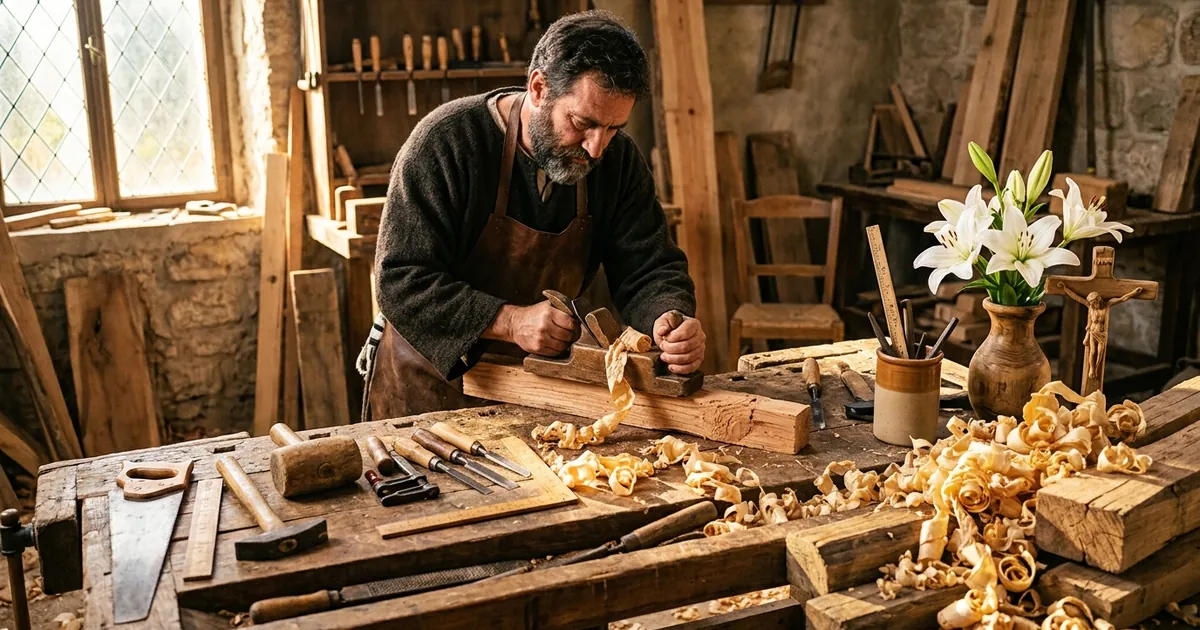
The Gospels identify Joseph as a tekton, often translated carpenter or craftsman. The term can describe skilled manual work more broadly than one modern job title. The Gospel does not give a detailed work biography, but it places Jesus' family within ordinary labor, responsibility, and hidden life.
Catholic reflection on work can include:
- paid employment and skilled trades;
- farming, domestic labor, and caregiving;
- office, creative, educational, and professional work;
- study and preparation for a vocation;
- volunteer service and the work of rebuilding after illness or displacement.
Human worth does not depend on salary, productivity, job title, or ability to work. At the same time, employers and institutions have responsibilities to prevent exploitation and provide safe, fair conditions.
Work is not only a punishment
Genesis describes the difficulty that enters human work through sin, but work itself is not presented as worthless. Catholic teaching can see work as participation in creativity, service, provision, and the development of the world. Redemption does not make every workplace holy by declaration; it calls people to transform work through justice, truth, rest, and care.
Offering work to God should never be used to justify stolen wages, harassment, discrimination, unsafe conditions, or the destruction of a person's health. Seeking fair treatment is compatible with prayer.
A five-minute May 1 practice
- Name the people whose labor made your day possible.
- Pray the Saint Joseph the Worker prayer above.
- Do one task with care instead of resentment or haste.
- Thank a worker without treating gratitude as a substitute for fair pay.
- Support a worker, union, parish ministry, or community service in a practical way when appropriate.
If you are unemployed, see Prayers for Employment. The dignity of your life is not suspended until you receive an offer.
Rest and the limits of work
Work is not the whole of life. Rest, worship, family, friendship, health, and care for the vulnerable are not wasted time. A devotion to Saint Joseph the Worker should make room for Sabbath, reasonable limits, and help when the workload is harming body or mind.
Sources & Tradition
Frequently asked questions
What is the Catholic meaning of May 1?
For Catholics, May 1 is associated with Saint Joseph the Worker, a feast that honors human labor and calls for work to respect the dignity of people, families, and communities.
Why is Saint Joseph called the Worker?
The Gospels identify Joseph as a tekton, commonly translated carpenter or craftsman. Catholic devotion remembers his hidden work and care for Jesus and Mary as a model of faithful service.
Is Saint Joseph the Worker a holy day of obligation?
Obligations vary by country, bishops' conference, and local calendar. Check your parish or diocese for current Mass and obligation guidance.
Can office work or housework be offered to God?
Yes. Any honest work or care can be offered in prayer. That does not mean all work conditions are acceptable; justice, safety, fair pay, and rest remain important.
Does praying to Saint Joseph guarantee a job or promotion?
No. The feast honors work and asks for intercession, but it does not guarantee employment, promotion, profit, or a particular workplace outcome.