page / saint biography and accessible philosophy-spirituality guide
Saint Augustine of Hippo: The Restless Heart and the Search for God
Explore Saint Augustine's restless heart, conversion, *Confessions*, teaching on grace, Saint Monica's prayer, and hope from *The City of God*.
Part of the Saints prayer collection.
In brief
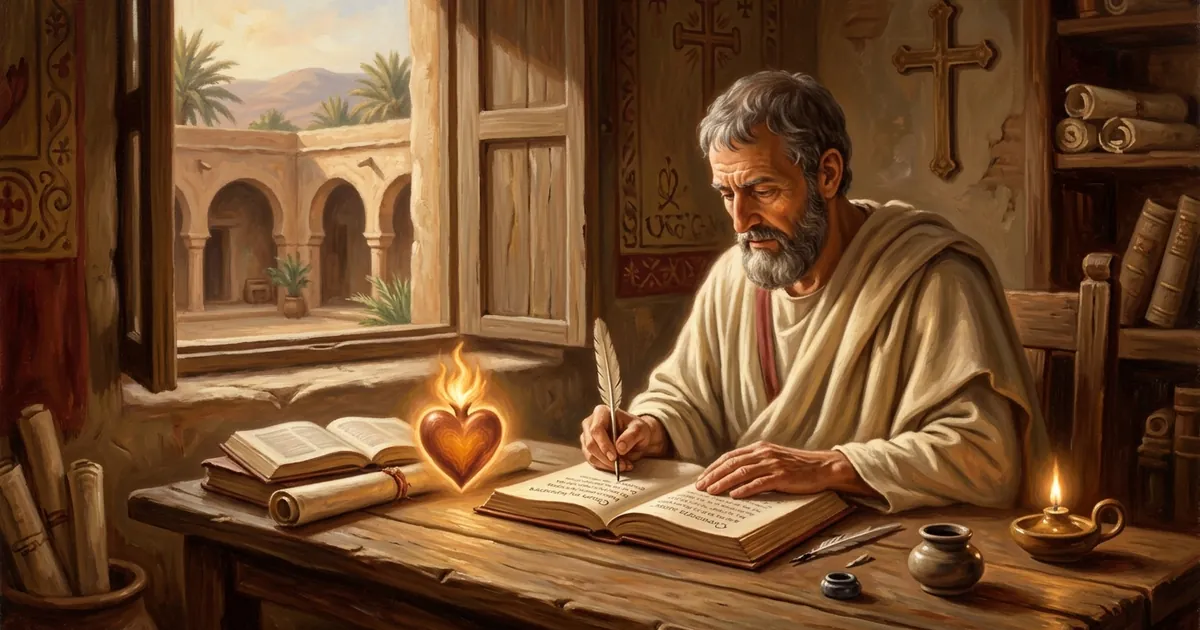
Saint Augustine of Hippo (354–430) was a Christian bishop, philosopher, theologian, and writer whose work shaped Western Christianity. His Confessions tells the story of a long search through ambition, relationships, philosophy, and religious movements before his conversion and baptism. His central spiritual insight is that human desire is real and powerful but becomes restless when it seeks an infinite fulfillment from finite things.
Augustine is also known as the Doctor of Grace because he insisted that salvation begins and continues through God's grace, not human self-sufficiency. His mother, Saint Monica, became an enduring model of patient intercession. His City of God teaches Christians not to confuse any earthly empire, party, or institution with the eternal city of God.
Confessions*: prayer as autobiography
The Confessions is both a story of Augustine's life and a prayer addressed to God. It asks not only “What happened?” but “What was my heart seeking, and how was grace already at work?” That approach can turn a life review into prayer without denying responsibility.
You can imitate the method without writing a book:
- Tell the truth about one period of your life.
- Name the good you wanted and the harm you caused or received.
- Notice where people, Scripture, or grace helped you.
- Ask forgiveness and accept appropriate accountability.
- Give thanks for one sign of mercy and choose one repair.
A prayer with Saint Augustine and Saint Monica
> God of mercy, you met Saint Augustine in the middle of a long search and answered Saint Monica's patient prayer with grace. Find me in my divided desires. Teach me to recognize the good I am seeking, to stop asking finite things to save me, and to accept the help that leads to freedom. Pray for [Name], especially if they are far from faith or trapped in a destructive habit. Give us honesty without shame, patience without control, and hope rooted in Christ. Amen.
A life of searching
Augustine was born in Thagaste in North Africa and educated for a career in rhetoric. He wanted intellectual success, professional recognition, and a satisfying life, but he also experienced the instability of a divided will. He joined Manichaeism for a time, later questioned it, and became influenced by Platonist philosophy and the preaching of Ambrose of Milan.
His story is not a simple tale of a bad young man becoming instantly perfect. Conversion was a process of learning, grief, friendship, prayer, Scripture, and grace. He was baptized by Ambrose in Milan in 387 and later returned to North Africa, where he became a priest and then bishop of Hippo.
Readers should avoid using the details of his early relationships to shame people today. Augustine's writings can help people name desire and responsibility, but a modern person may need trauma-informed therapy, medical care, addiction treatment, or pastoral support alongside prayer.
“Our hearts are restless”
At the opening of the Confessions, Augustine addresses God as the one who made human beings for himself and describes the heart as restless until it rests in God. The line is not an insult to ordinary desires. Hunger, friendship, sexuality, achievement, beauty, and security can all point toward real goods.
The problem arises when a finite good is asked to carry the weight of an infinite promise. A relationship cannot bear the demand to solve every loneliness. Money cannot guarantee safety from death. Achievement cannot give an unshakable identity. Pleasure cannot remove every wound. Augustine's insight is that desire needs education and ordering, not simple destruction.
Try asking three questions about a strong desire:
- What good am I actually seeking?
- What am I asking this finite thing or person to provide?
- What truthful, loving action would place the desire in a healthier order?
This reflection does not replace treatment for addiction, compulsive behavior, depression, or trauma. It can be a spiritual companion to professional care.
Grace and the divided will
Augustine's famous prayer about wanting chastity while not wanting it yet expresses a divided will. It should not be quoted to excuse sin or to mock people who struggle. His point is that insight alone does not always produce freedom. A person may know what is good and still need healing, habits, community, accountability, and grace to choose it.
In his debates with Pelagius and later theological opponents, Augustine emphasized the priority of grace and the wound of sin. Catholic teaching also insists that human beings have real freedom and responsibility. Grace does not turn people into puppets; it heals and elevates freedom so that love becomes possible.
The doctrine of grace should not make a person passive. Pray for help, receive the sacraments, tell the truth, remove occasions of harm, ask for accountability, and take practical steps. “I need grace” is not an excuse to avoid the help God may provide through people and institutions.
Saint Monica's tears
Saint Monica prayed for Augustine through years of distance, disappointment, and change. She sought counsel from bishops and followed him across the Mediterranean before his conversion. The Confessions remembers her as a mother whose persistence was joined to patience and trust.
Her story can encourage parents praying for a child or spouse, but it must not create a guarantee that a loved one will make a particular choice. Intercession respects freedom. It also does not require stalking, financial control, emotional blackmail, or the abandonment of personal safety.
If you are praying for a prodigal child, you can ask for grace while keeping communication respectful, setting boundaries, seeking family counseling, and caring for your own health. Monica's tears are not a formula that forces conversion; they are a witness to patient love.
The City of God*: hope beyond collapse
Augustine wrote The City of God after Rome was sacked in 410 and Christians were blamed for the empire's troubles. He distinguished the earthly city, shaped by disordered self-love, from the City of God, shaped by love of God and neighbor. The work is not a simple map showing which modern country or political group is “the City of God.”
Its enduring lesson is that no empire, nation, party, economy, or church institution should carry the weight of ultimate hope. Christians can work for justice in public life while refusing to treat political success as salvation. This is especially important when people are afraid: grief and responsibility remain real, but history is not finally controlled by the loudest power.
Related prayers and guides
Anti-thin-content test
- Clear reason to exist: connects Augustine's biography, restless desire, grace, Monica, Confessions, City of God, and practical conversion.
- Practical usefulness: offers reflection questions, a life-review method, a prayer, and boundaries for addiction, grief, and family intercession.
- Distinctive depth: translates difficult theology without denying freedom, accountability, professional care, or historical complexity.
- Intent satisfied: a reader can understand Augustine's central ideas and use them to examine desire and hope today.