saint biography / practical spirituality
St. Benedict of Nursia: Prayer, Work, and a Rule for Life
Learn who St. Benedict was and how Benedictine principles of prayer, work, moderation, stability, and hospitality can help ordinary Catholics live with purpose.
Part of the Saints prayer collection.
In brief
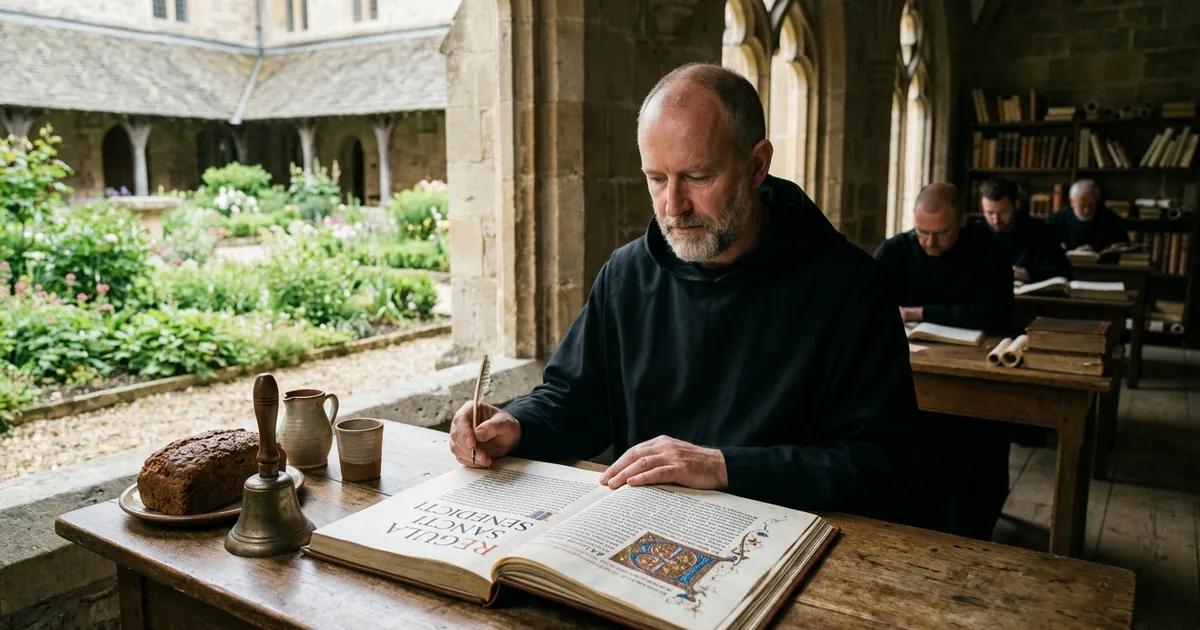
Saint Benedict of Nursia was a sixth-century Christian monk whose Rule became one of the most influential guides for Western monastic life. It teaches attentive listening, prayer, work, obedience, humility, moderation, community, and hospitality. Lay Catholics do not need to become monks to learn from Benedict, but they should adapt the principles rather than copy monastic vows or schedules literally.
The phrase ora et labora—“pray and work”—summarizes a Benedictine instinct, even though it is not a one-line motto that appears as the complete title of every chapter of the Rule. It can help a family or worker ask whether prayer and responsibility are being separated, while remembering that rest, recreation, relationships, and care for the body also belong to a faithful life.
Ora et labora: prayer and work
Benedictine spirituality resists the idea that only explicitly religious activities matter. Prayer gives work its proper horizon, and work can become an offering when done honestly and for the good of others. A parent caring for a child, a cleaner maintaining a home, a nurse serving a patient, and an office worker doing careful work can all bring responsibility into prayer.
At the same time, work can become an idol. A lay adaptation of ora et labora might include:
- a short morning offering;
- one protected pause for prayer during the workday;
- honest limits on after-hours work;
- completing an ordinary task with attention rather than resentment;
- a brief examination at night: what was received, neglected, repaired, or entrusted to God?
Prayer is not a productivity hack, and a routine cannot guarantee that exhaustion will disappear. Burnout may require medical, psychological, workplace, or family intervention. Spiritual discipline should support responsible care, not blame an exhausted person for lacking enough faith.
Who was Saint Benedict?
Benedict was born in Nursia in central Italy, probably around 480. After a period of solitude, he gathered disciples and founded communities, most famously at Monte Cassino. The Dialogues of Pope Gregory the Great, written after Benedict's death, are the principal early narrative source and include stories of miracles and spiritual insight. They are important for Benedictine memory, but they are not a modern biography with complete dates and documentation.
The Rule emerged from this experience of community. It is neither a productivity manual nor a collection of mystical shortcuts. It is a school of Christian discipleship in which people learn to seek God through prayer, work, obedience, stability, correction, and patient life with others.
The Rule begins with listening
The Rule's opening call to “listen” is a practical spiritual discipline. Before reacting, the disciple receives God's word, the wisdom of the Church, the needs of the community, and the truth about personal weakness.
For a layperson, listening can mean:
- reading a short Gospel passage before checking messages;
- allowing another family member to finish speaking;
- asking what responsibility a difficult situation actually requires;
- receiving correction without turning every suggestion into an attack;
- consulting a pastor, counselor, doctor, or qualified expert when a problem exceeds personal knowledge.
Listening is not passivity. It creates the attention needed for a responsible response.
Moderation and sustainable holiness
Benedict's Rule pays attention to food, sleep, work, prayer, age, illness, and individual capacity. It assumes that a community needs order without turning discipline into competition. A layperson can apply this through sustainable habits: a realistic prayer length, a regular bedtime, a weekly day of rest, a simple budget, and a willingness to reduce commitments that are destroying family life.
Moderation is not indifference. It means choosing what supports love and persevering in it without confusing extreme effort with holiness. A small practice kept faithfully can form a person more deeply than a dramatic plan abandoned after a week.
Hospitality: receive the guest with reverence
The Rule gives guests an important place and tells the community to receive them with honor. In a home, Benedictine hospitality may mean welcoming a lonely relative, feeding a neighbor, making room for a child who needs safety, or treating a service worker with dignity. It does not mean giving every stranger unrestricted access to a home or ignoring safeguarding and privacy.
Christian hospitality includes wise boundaries. A family can offer a meal, referral, parish contact, or practical help without placing a vulnerable person at risk. Hospitality is generous and discerning at the same time.
Stability, obedience, and lay life
Stability is a monastic commitment to remain with a particular community. A lay Catholic should not claim to have taken a monastic vow simply because he or she decides to stay in one neighborhood or parish. The principle can still prompt a question: where am I called to practice patience, repair relationships, and serve rather than constantly escape discomfort?
Obedience in the Rule is ordered toward seeking God and living the community's vocation. It does not authorize abuse, coercive control, or blind submission to a leader. Laypeople retain moral responsibility and should seek help when a religious or family authority demands something harmful or unlawful.
The domestic church and Saint Joseph
Saint Benedict and Saint Joseph offer complementary examples for a Catholic home: Benedict gives a pattern of ordered prayer and community; Joseph models hidden work, protection, and obedience in the Gospel. A household can create a modest rule of life: a prayer time, shared meal, weekly act of mercy, realistic division of chores, Sunday worship, and a way to repair conflict.
Write it on one page, review it every few months, and change what no longer serves the family's actual vocation. A rule of life is a servant, not a master.
Related reading
Anti-thin-content test
- Clear reason to exist: it translates Benedictine wisdom into a safe, realistic lay framework.
- Practical utility: prayer rhythm, work boundaries, moderation, hospitality, and a household rule are actionable.
- Original depth: history, Rule, burnout caution, safeguarding, and Saint Joseph are integrated.
- Trust boundary: no productivity promise, false monastic equivalence, or permission for coercive authority.