page / saint biography, charity, and spiritual-dryness guide
Saint Mother Teresa: Love in the Darkness and the Face of the Poor
Learn how Saint Mother Teresa served the poor, what “distressing disguise” meant, how to understand her spiritual darkness, and how to serve without romanticizing suffering.
Part of the Saints prayer collection.
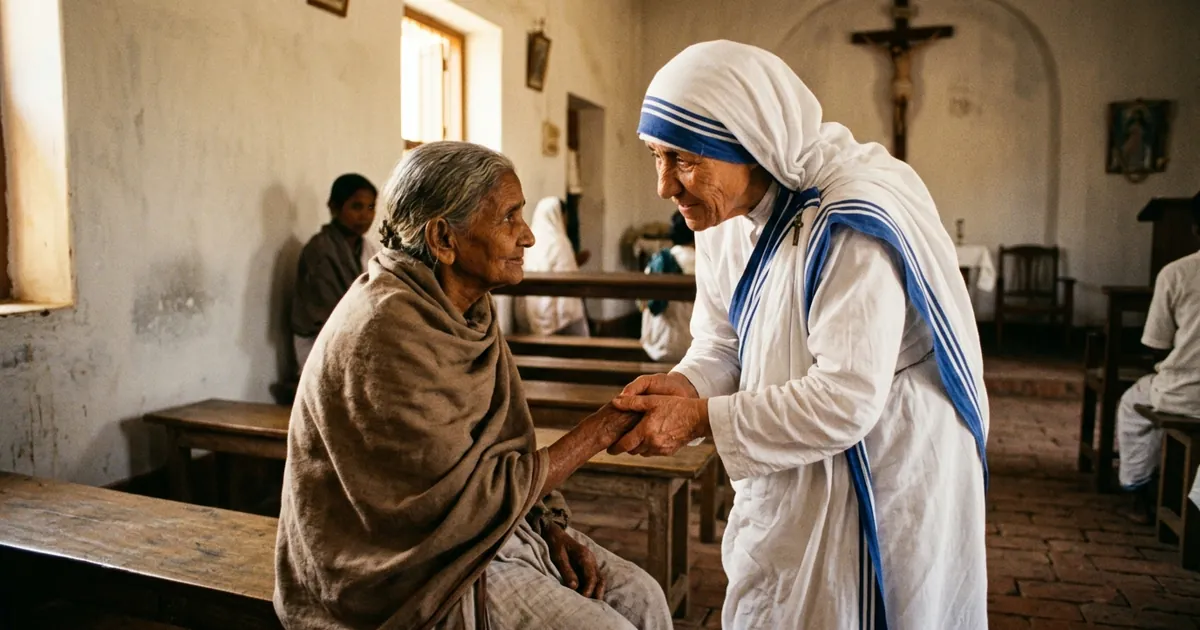
In brief
Saint Mother Teresa of Calcutta (1910–1997) was a Catholic religious sister who founded the Missionaries of Charity and devoted her life to people who were poor, sick, dying, homeless, or rejected. Her spirituality joined Eucharistic prayer with close, practical service. After her death, private letters revealed decades of spiritual darkness and a lack of felt consolation. Those letters do not prove that she abandoned faith; they show that her visible service continued while her inner experience was often painful and hidden.
Her legacy should be received with both gratitude and honest questions. Caring for a dying person requires love, hygiene, pain relief, trained staff, and appropriate medical or palliative care. Christian charity is not measured by how much preventable suffering an institution tolerates. Mother Teresa's emphasis on dignity can inspire service while legitimate concerns about standards and systems are examined responsibly.
A prayer for service and spiritual dryness
> Jesus, hidden in the poor and present in the Eucharist, teach me to see each person with dignity rather than as a project. When prayer feels empty, keep me honest and send me the help I need. Give me compassion with boundaries, courage with humility, and love that becomes competent action. Saint Mother Teresa, pray for caregivers, the dying, the homeless, the lonely, and all who feel abandoned. May our service protect life, relieve suffering, and respect every person's freedom. Amen.
If your spiritual darkness includes thoughts of self-harm or inability to stay safe, contact local emergency services or a crisis line and tell someone you trust. This is an act of preserving life, not a spiritual failure.
A life of response
Agnes Gonxhe Bojaxhiu was born in Skopje in 1910 and entered the Sisters of Loreto. She served as a teacher in India before reporting an inner call to work among people living in extreme poverty. The Missionaries of Charity began in Calcutta and later spread to other countries.
Her communities served through homes for people who were dying, orphanages, shelters, clinics, food distribution, and direct accompaniment. The exact programs and standards varied by place and time. A page about her should not turn a complex global organization into a single photograph or a simple slogan.
Mother Teresa was canonized in 2016. Canonization recognizes the Church's judgment about a person's holiness and intercession; it does not mean that every management decision, quotation attribution, news report, or institutional practice is beyond examination.
The “distressing disguise” of the poor
Mother Teresa often spoke of meeting Jesus in people who were poor and rejected. The phrase “distressing disguise” described the way Christ's presence in the vulnerable can be hidden beneath illness, dirt, hunger, social stigma, or fear. It echoes Matthew 25, where Jesus identifies service to the hungry, thirsty, sick, imprisoned, and stranger with service to him.
This does not mean that a poor person is merely a religious object or that suffering makes someone holy. The person has a name, freedom, rights, preferences, and a voice. Serving people “as Christ” requires consent where possible, safeguarding, competent care, and listening to what they actually need.
It is also important to distinguish Christ's presence in the poor from the Eucharistic presence taught by Catholic doctrine. The two forms of devotion are connected in a life of charity, but they are not identical claims. Mother Teresa's spirituality should lead to reverence for both sacrament and person.
“I thirst” and practical love
Mother Teresa placed the words “I thirst” from Jesus' cry on the Cross at the center of her spirituality. She understood that Christ thirsts for love and for people to receive mercy. The phrase also points to literal thirst: clean water, nutrition, pain relief, safety, and human touch matter.
A practical response to “I thirst” may be bringing water to someone, supporting a clinic, learning first aid, advocating for housing, sitting with a dying person, or challenging a policy that treats people as disposable. Prayer without care becomes sentiment; care without respect can become control.
The darkness revealed in her letters
The publication of letters in Come Be My Light showed that Mother Teresa experienced long periods in which she felt no closeness to God and little consolation in prayer. Some accounts connect the beginning of this experience with the years after her call to serve the poor; the precise timeline and spiritual interpretation require careful reading of the letters and biographical context.
Did she lose her faith? The letters alone cannot give a simple psychological diagnosis. Her continued prayer, vows, Eucharistic life, service, and fidelity are consistent with a spiritual darkness in the tradition of Christian mysticism, but “dark night of the soul” should not be used as a label for every depression or frightening experience. San Juan de la Cruz's mystical teaching is not a replacement for a clinician's assessment.
Spiritual dryness can mean that prayer feels empty, but depression can also include exhaustion, hopelessness, sleep or appetite changes, loss of interest, and thoughts of death. A person should seek medical or mental-health care when symptoms are severe or persistent. God is not honored by refusing help.
Love without emotional reward
Mother Teresa's public smile and private darkness reveal an important distinction: love is not identical to a warm feeling. A person can choose fidelity and care when consolation is absent. At the same time, this insight must not be weaponized against people who are depressed, traumatized, or exhausted. They may need rest, medication, therapy, medical treatment, boundaries, or a change of environment.
Christian charity is not endless self-erasure. Jesus also withdrew to pray, accepted hospitality, and permitted others to serve him. A volunteer who needs supervision, rest, or professional support is not failing in love.
Answering criticism fairly
Mother Teresa has been criticized over the quality of medical care, financial transparency, relationships with powerful people, and the way suffering was described in her public language. Some criticisms contain specific factual claims that require source-by-source investigation; others are polemical. Defending her holiness does not require dismissing all questions.
A fair evaluation can hold several truths together: she drew global attention to people whom many ignored; individual caregivers served with courage; institutions can still have serious shortcomings; and people who are dying deserve both tenderness and competent care. The answer to poor care is not contempt for the poor or contempt for religion; it is better accountability and service.
The spirituality of small acts
Mother Teresa repeatedly emphasized serving one person at a time and doing small things with love. The principle is not a reason to ignore systems. A meal can help one person today while advocacy addresses the causes of hunger tomorrow. A volunteer can sit at a bedside while a hospital improves pain management and staffing.
Choose a form of service that matches your skills and limits. Do not enter a medical or social-care setting without training. Respect confidentiality, consent, safeguarding rules, and the direction of professional staff.
Related prayers and guides
Anti-thin-content test
- Clear reason to exist: explains Mother Teresa's service, “distressing disguise,” spiritual darkness, criticism, small acts, and care for the dying.
- Practical usefulness: offers a prayer, safe service guidance, mental-health boundaries, and a clear distinction between devotion and clinical care.
- Distinctive depth: holds spiritual witness, human dignity, institutional accountability, and honest criticism together without mockery or hagiographic denial.
- Intent satisfied: a reader can understand her legacy, pray through dryness, and serve another person more responsibly.