saint biography
St. Nicholas of Bari: The Bishop Behind the Santa Claus Legend
Meet St. Nicholas of Myra, the Christian bishop remembered for charity and faithful witness, and discover how history, tradition, and Santa Claus became connected.
Part of the Saints prayer collection.
In brief
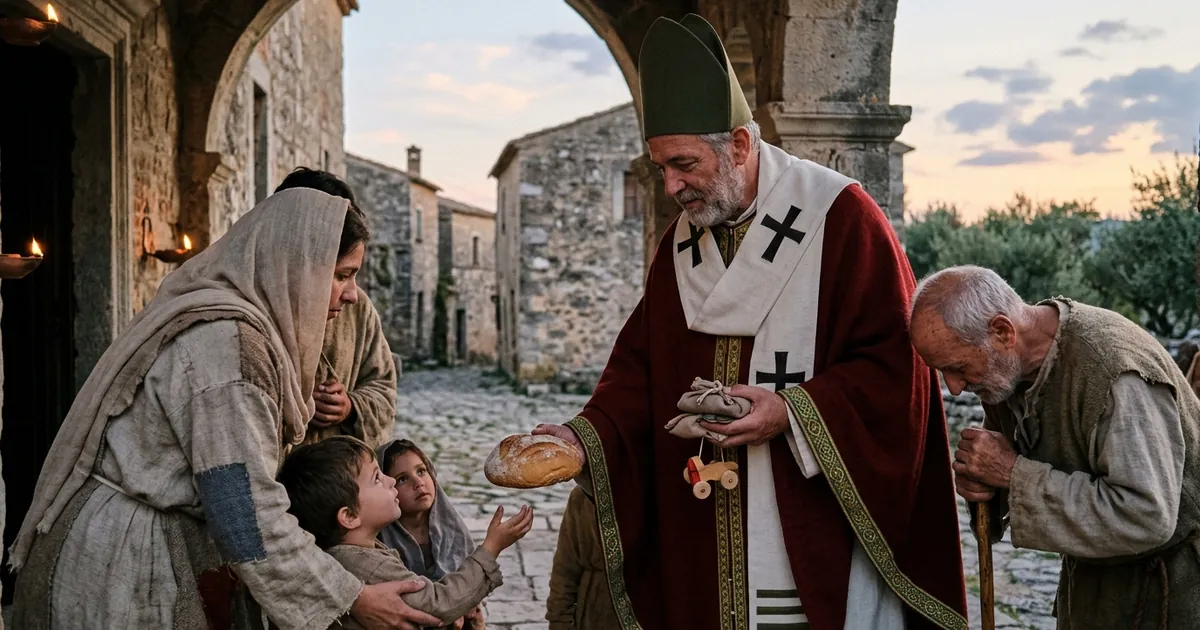
Saint Nicholas of Myra was a Christian bishop from Lycia in Asia Minor, probably living in the late third and early fourth centuries. Christian tradition remembers him for generous care of people in need, courageous pastoral leadership, and faith in Christ during a period when the Church suffered persecution. His name later traveled through Europe and became connected with the figure of Santa Claus, but the historical saint was not a secular gift character. He was a bishop whose charity pointed to God and to the dignity of vulnerable people.
Many details about Nicholas come from later biographies and local tradition. A trustworthy account distinguishes what is historically likely, what is preserved in ecclesial memory, and what cannot be proved from contemporary evidence.
A prayer to Saint Nicholas
This original prayer is a devotional composition, not an official liturgical text:
> Saint Nicholas, faithful shepherd and generous servant of Christ, teach us to notice people in need and to give without seeking praise. Pray that our homes may be truthful, our gifts may protect dignity, and our faith may become practical mercy. Help children grow in joy without fear and adults to serve with wisdom. Lead us closer to Jesus, who is the source of every good gift. Amen.
Nicholas, Bishop of Myra
Nicholas is traditionally identified as bishop of Myra, a city in Lycia, in present-day Türkiye. The early documentary record about his life is limited, but his cult became widespread in both Eastern and Western Christianity. His feast is celebrated on December 6 in many calendars.
The title “Wonderworker” reflects the many miracles associated with his intercession in later devotion. It is not a reason to turn every story into a modern news report. The saint's central witness is more stable: Christian leadership, generosity, prayer, and care for people at risk.
Persecution and faithful witness
Later tradition places Nicholas among the bishops who suffered during the persecution of Christians under the Roman emperors before Constantine. He is often described as imprisoned or deprived of public ministry. Because the surviving evidence does not give a complete biography, the exact circumstances should be stated with appropriate words such as “tradition remembers” or “later accounts say.”
Whether a particular detail can be reconstructed, the spiritual meaning is clear: a bishop's ministry is not measured by comfort or public approval. Christian witness can include endurance, care for prisoners, defense of truth, and patient service when circumstances are difficult.
Was St. Nicholas at the Council of Nicaea?
Some lists and later traditions name Nicholas among the bishops at the First Council of Nicaea in 325, which defended the Church's confession that the Son is truly divine. Modern historians note that the surviving records do not make every traditional participant equally certain. It is therefore better to say that Nicholas is traditionally associated with Nicaea than to present an uncontested attendance record.
The council's theological importance is certain: the Church confessed the faith expressed in the Nicene Creed against teachings that reduced Christ's divine identity. A devotion to Saint Nicholas should never turn the story into a boxing match. His relevance is his love for the truth about Jesus and his care for the people entrusted to him.
Did Nicholas slap Arius?
The famous story says that Nicholas became so distressed by Arius's teaching that he struck him during the council. The episode appears in later accounts and is deeply embedded in popular devotion, but it is not established by the earliest surviving evidence as a simple fact.
The story should not be used to excuse violence, public humiliation, or angry theological behavior. If it is told to children, describe it as a later tradition and explain that Christians defend truth through faithful teaching, self-control, and charity. A saint's holiness is not a permission slip for assault.
The three maidens and secret charity
One of the best-known stories says that Nicholas secretly gave money to a poor father so his three daughters could avoid extreme hardship. Versions differ about the family's circumstances and how the gift was delivered. The moral center is consistent: he protected dignity by giving quietly rather than seeking applause.
This story helped connect Nicholas with gifts at Christmas. Its Christian lesson is not “give expensive presents to prove love.” It is to notice people whose needs are hidden, protect their dignity, and give in a way that truly helps. Adults should also avoid presenting marriage, dowries, or poverty as simple problems solved by a single bag of coins.
From Saint Nicholas to Santa Claus
The modern Santa Claus figure developed through a long cultural history involving Saint Nicholas, Dutch and European customs, local folklore, literature, advertising, and family traditions. Santa Claus is not identical to the bishop of Myra, but the connection to secret generosity remains visible in many customs.
Families can keep a joyful gift tradition while telling children that the Christian saint lived for Christ and the poor. A gift is not a magical reward for perfect behavior, and Saint Nicholas is not watching children as a surveillance figure. The feast can invite gratitude, generosity, and prayer.
Relics and Bari
After Nicholas's death, his veneration continued at Myra. In 1087, sailors from Bari brought many of his relics to the Italian city, where the Basilica of San Nicola became an important pilgrimage site. The movement of relics is remembered differently in different communities, so the page should describe the event respectfully without turning a contested medieval transfer into a simplistic “rescue” or accusation.
The “manna” associated with the tomb is part of the basilica's devotional tradition. Claims about healing should be presented as reports of devotion, not medical evidence or a guarantee that touching a relic will produce a result. Catholics may ask a saint's intercession while continuing appropriate medical care.
Related reading
Anti-thin-content test
- Clear reason to exist: it restores the historical and Christian person behind a familiar cultural character.
- Practical utility: it gives parents language for explaining history, legend, gifts, and charity.
- Original depth: persecution, Nicaea, the disputed slap, the maidens, Bari, and Santa Claus are separated and contextualized.
- Trust boundary: no fabricated certainty, miracle guarantee, or violent imitation.