page / saint biography, philosophy, and eucharistic catechesis
Saint Thomas Aquinas: Faith, Reason, and Eucharistic Wonder
Discover Saint Thomas Aquinas beyond the Five Ways: his harmony of faith and reason, the *Summa Theologica*, Eucharistic hymns, and final mystical prayer.
Part of the Saints prayer collection.
In brief
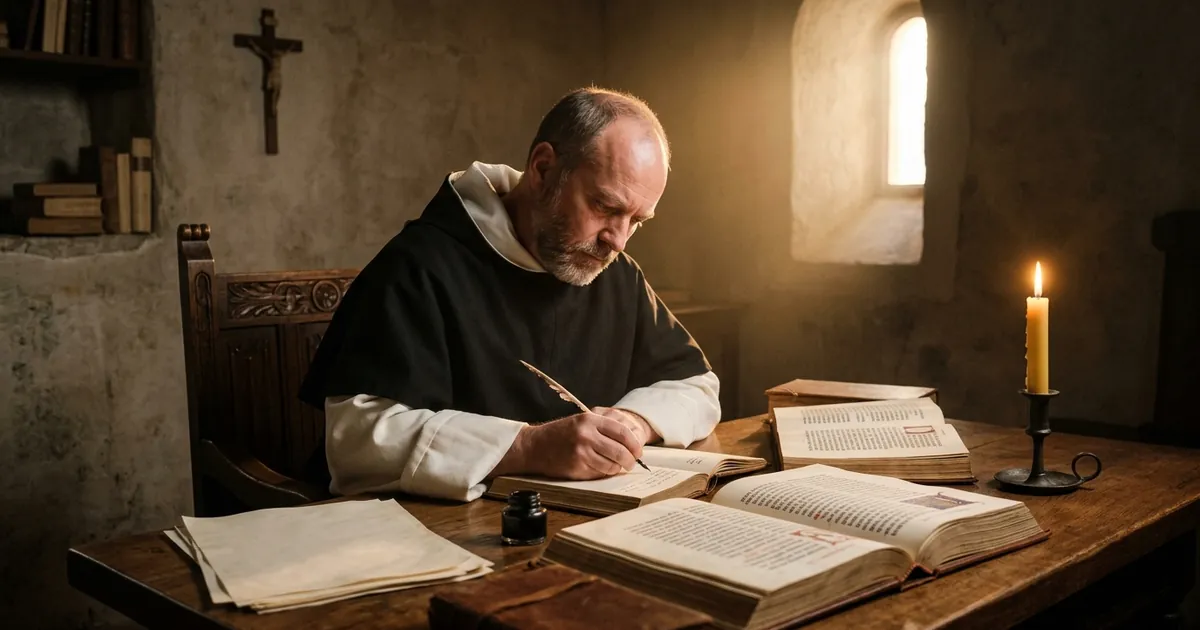
Saint Thomas Aquinas (c. 1225–1274) was a Dominican friar, priest, theologian, philosopher, and teacher whose work became one of the major expressions of Catholic theology. He is called the Angelic Doctor and is best known for the Summa Theologica, his Five Ways, and his account of the relationship between faith and reason.
Thomas was not a detached logic machine. He wrote as a Christian who prayed, celebrated the Eucharist, composed hymns, and believed that truth ultimately comes from God. His method can help modern readers hold intellectual rigor and devotion together: science and philosophy study what reason can discover, while faith receives God's revelation. Apparent conflicts require careful examination of both the evidence and the interpretation.
A prayer before study or adoration
> Lord Jesus Christ, source of all truth, give me the humility to learn, the patience to reason carefully, and the courage to follow truth when it challenges me. Through the intercession of Saint Thomas Aquinas, unite my study with prayer and my knowledge with charity. When I come before the Eucharist, quiet my pride and help me adore the mystery I cannot possess. May grace perfect the gifts you have given me. Amen.
Before studying, write one question you genuinely want to understand. Before adoration, leave the question in God's presence without demanding an immediate intellectual solution.
A brief life
Thomas was born into a noble family near Aquino in Italy and joined the Dominicans despite family opposition. He studied under Albert the Great, taught at universities in Paris and Italy, preached, wrote, and advised Church leaders. His life was marked by travel, intense intellectual work, community responsibilities, and a vocation to serve the Church through teaching.
His nickname “Dumb Ox” is traditionally attributed to Albert the Great, who reportedly recognized the power of Thomas's quiet intelligence. The story is devotional and should not be used to portray Thomas as socially deficient. His quiet manner, careful method, and enormous output show a person whose thought was disciplined by prayer and study.
Faith and reason
Thomas held that faith and reason cannot ultimately contradict one another because both truth and revelation come from God. Reason can investigate the created world, logic, morality, and the existence of God. Faith receives truths that God reveals and that human reason could not discover by itself, such as the Trinity and the Incarnation.
The two forms of knowledge are not interchangeable. A microscope cannot measure grace, and a doctrine cannot replace a clinical trial. But a scientific claim should not be rejected merely because it is scientific, and a theological claim should not be reduced to a laboratory hypothesis. When an apparent conflict appears, examine the evidence, the philosophical assumptions, the interpretation of Scripture, and the interpretation of the data.
Thomas's principle that grace perfects nature means that God's grace does not erase human intelligence, embodiment, culture, or ordinary work. It heals and elevates them. A Catholic can study medicine, physics, history, and philosophy without fearing that learning will destroy faith.
The *Summa Theologica
The Summa Theologica is a large theological work arranged through questions, objections, answers, and replies. Thomas often begins by presenting strong objections to his own position, then gives a central response, and finally addresses each objection. This structure models intellectual charity: understand the other side accurately before criticizing it.
The Summa was written as a teaching aid for beginners in theology, but its vocabulary and assumptions can still be difficult. Read a good introduction, use a reliable translation, and take one question at a time. The work is not a collection of social-media quotations; arguments depend on context and definitions.
The Five Ways
The Five Ways appear in the Summa as concise arguments for the existence of God. They are not five versions of the modern “watchmaker” argument and do not picture God as a mechanic who started the universe and walked away. They reason from features of the world toward a first or necessary source of existence and order.
- Change or motion: things move from potential to actual through the activity of something already actual; the argument asks about an ultimate source of change.
- Efficient causality: effects depend on causes; the argument asks whether dependent causal series ultimately require a first cause that is not itself caused in the same way.
- Contingency: many things can exist or fail to exist; the argument asks why contingent beings exist at all rather than nothing.
- Degrees: people speak of more and less goodness, truth, or nobility; the argument reasons toward a source or standard of such perfections.
- Goal-directed activity: natural things act regularly toward ends even without conscious planning; the argument asks about an intelligent source of this order.
These arguments depend on metaphysical premises and have been interpreted and criticized by philosophers. They are not a shortcut that forces belief after five sentences. They invite careful reasoning about being, causality, dependence, and purpose. Thomas's God is not merely a designer; God is the source who sustains created being.
The Eucharistic theologian
Thomas wrote liturgical texts and hymns for the Feast of Corpus Christi, including works traditionally associated with Pange Lingua, Tantum Ergo, and Adoro Te Devote. His Eucharistic theology is not an ornamental addition to his philosophy. For Thomas, the same mind that asks what existence means kneels before Christ present in the sacrament.
The exact historical details of Thomas's private prayer and tears should be received from reliable biographies and traditions. The broad picture is clear: his scholarship served worship. Intellectual study should not become pride, and devotion should not become contempt for truth.
Why did Thomas stop writing?
Near the end of 1273, after an experience during Mass or prayer, Thomas stopped writing and dictated that he could do no more, comparing his work to straw in light of what had been revealed. The wording and the precise nature of the experience are preserved through later testimony and tradition, so do not present it as a stenographic transcript from the altar.
The story is not an attack on scholarship. It expresses a Christian hierarchy: theological words are valuable, but God is not contained by a book. Study should lead to wonder and worship rather than the illusion of mastery.
Related prayers and guides
Anti-thin-content test
- Clear reason to exist: integrates biography, faith and reason, Summa method, Five Ways, Eucharistic writing, final mystical tradition, and prayer.
- Practical usefulness: offers a study method, an original prayer, and a way to connect intellectual work with adoration.
- Distinctive depth: corrects the watchmaker caricature and presents Thomas's arguments and mysticism with historical and philosophical limits.
- Intent satisfied: a reader can understand the core ideas, study responsibly, and pray with Thomas's Eucharistic vision.