tool / family education guide
Catholic Homeschooling Resources: A Practical Family Guide
Learn how to begin Catholic homeschooling, compare educational approaches, build a prayerful daily rhythm, and choose trustworthy resources without overspending.
Part of the Tools prayer collection.
In brief
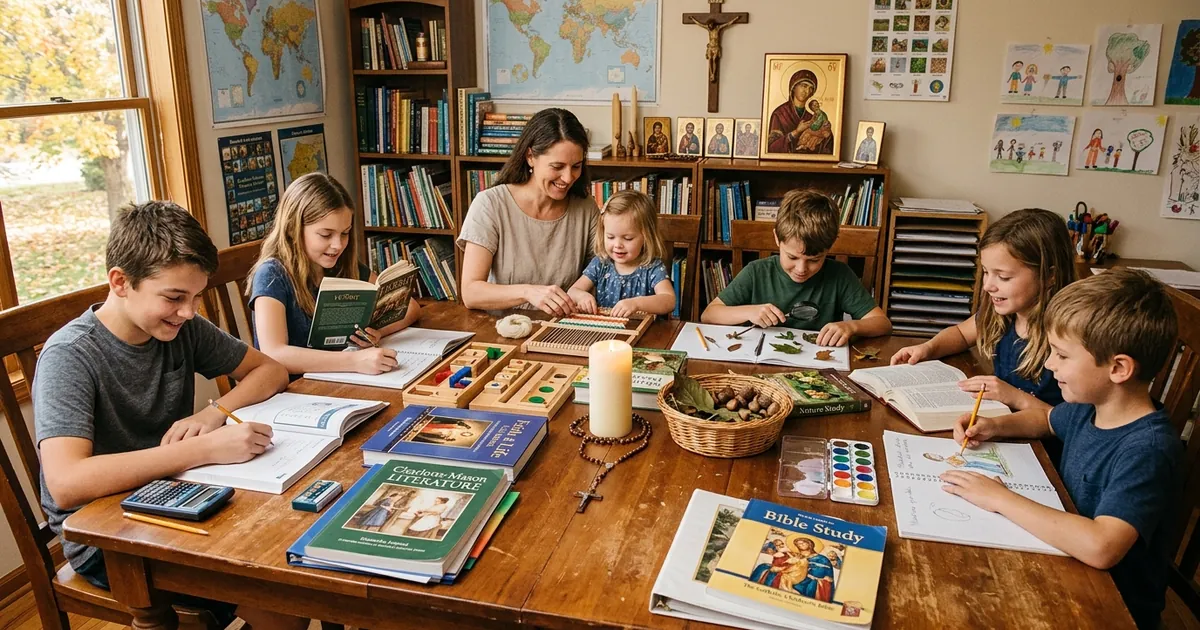
Catholic homeschooling works best when a family chooses a manageable academic plan, follows its local education requirements, builds a healthy household rhythm, and treats parents as the primary educators without pretending they must teach every subject alone. The goal is not to recreate a school building in the living room or add prayers to every worksheet. It is to educate the whole person—mind, character, body, relationships, and faith—while using qualified help where the family needs it.
Before buying a curriculum, write down your children's ages and learning needs, the subjects required in your location, your available time, your budget, and the kind of support you need. A beautiful program that cannot be used consistently is less helpful than a modest plan a family can sustain.
What Catholic education is trying to form
The Church describes parents as having a serious responsibility for their children's education. That responsibility is exercised with the support of the parish, school, wider family, and civil community; it does not mean that every parent must be an expert in mathematics, languages, special education, or adolescent development.
A Catholic family can ask of each subject:
- What knowledge and skill should the child actually gain?
- Does the material respect truth, human dignity, and the child's developmental stage?
- Does it invite wonder and disciplined reasoning rather than fear or propaganda?
- How will the child practice virtue—attention, honesty, perseverance, justice, charity—through the work?
- Where should a specialist, tutor, therapist, co-op, or school provide support?
Faith integration should be genuine. Science can cultivate wonder and intellectual honesty; history can examine real people and moral choices; literature can develop empathy and judgment. Not every page needs an explicit religious reference.
Step 1: Check requirements and capacity
- Research local rules. Registration, attendance, assessment, record keeping, and subject requirements vary by country, state, province, and sometimes district. Use the official education authority, not a social-media summary.
- List the children’s needs. Note reading level, attention, language, disability, health, strengths, and goals. Ask a qualified professional for assessment when concerns are significant.
- Set a realistic weekly rhythm. Include instruction, independent work, chores, exercise, rest, worship, appointments, and the adult's own work.
- Choose support before crisis. Identify a parish, co-op, tutor, special-education resource, library, or trusted family who can help.
- Protect the marriage and the home. Education is important, but a child should not become the battleground for adult perfectionism.
A simple domestic-church school day
This is a flexible pattern, not a religious obligation or a promise of productivity:
- Opening: Sign of the Cross, a short offering, Scripture, or a prayer for wisdom.
- Core learning: reading, writing, mathematics, and the subject that needs the child's best attention.
- Movement and practical work: outdoor time, chores, craft, music, or exercise.
- Shared reading: history, science, biography, or literature discussed together.
- Faith and family life: a short prayer, the saint or liturgical season, and a concrete act of service.
- Closing: put materials away, review what was learned, and name one thing for which the family is grateful.
Families may choose a decade of the Rosary, the Angelus, a psalm, or a simple prayer. If a long prayer routine causes resentment or exhaustion, shorten it. A domestic church grows through faithful ordinary practices, not through a schedule that makes everyone afraid.
How to compare curriculum approaches
Classical education
Classical programs often emphasize language, memory, history, logic, and rhetoric. They can suit children who enjoy structured sequence and discussion. Ask whether the reading load, pace, and expectations match your child's age and learning profile.
Charlotte Mason-inspired learning
Charlotte Mason approaches often use “living books,” narration, nature study, short lessons, and habits. They can encourage attention and wonder, but families should still check that mathematics, writing, science, and assessment are sufficiently covered.
Montessori-informed learning
Montessori-inspired practice emphasizes prepared environments, purposeful activity, and growing independence. Catholic families may also explore the Catechesis of the Good Shepherd, which has its own training and materials rather than being simply a label for any religious Montessori activity.
Textbook and online programs
Textbook, video, and online programs can give a family sequence, explanations, grading, and outside instruction. They may be especially useful for advanced subjects or a parent who works. Check privacy, screen time, teacher qualifications, accessibility, cost, and whether the program actually fits local requirements.
No method is automatically Catholic because of a logo. Evaluate the content, pedagogy, truthfulness, child protection, and family fit.
Resource categories to investigate
- Primary sources: the Bible, the Catechism, approved liturgical texts, historical documents, and public-domain classics where the edition is reliable.
- Libraries: public libraries, parish libraries, interlibrary loan, museum resources, and free digital collections.
- Saints and liturgical year: a parish calendar, age-appropriate biographies, feast-day art, music, service projects, and Scripture.
- Community: Catholic co-ops, parish religious education, sports, music groups, scouting, and friendships that include children outside the homeschool circle.
- Specialist support: tutors, speech and occupational therapists, counselors, physicians, and special-education professionals when needed.
Review any “free” resource for advertising, data collection, doctrinal accuracy, accessibility, and hidden printing or subscription costs. A resource is trustworthy because its content and practices are sound, not because it is expensive or branded Catholic.
A low-cost starting plan
For the first month, use the local library, one reliable mathematics resource, a writing and reading plan, a science notebook, a history read-aloud, and the Bible or a parish-approved catechetical resource. Keep a simple record of attendance, work, books, and questions. Add resources only when a real need appears. This protects the family from buying an entire curriculum before discovering how the children learn.
When homeschooling needs outside help
Ask for help when a child is not making expected progress, a disability is suspected, family conflict is escalating, a parent is near burnout, or a subject exceeds the adult's competence. Seeking a tutor, evaluator, therapist, doctor, or school consultation is not a failure of the domestic church. It is an act of responsibility.
Saint Joseph and the work of education
Saint Joseph's example can encourage parents to value patient work, protection, skill, and quiet fidelity. The Gospels do not give a detailed homeschool timetable for Nazareth, so the connection should remain a spiritual application rather than a historical claim. A family honors Saint Joseph by making the home safe for learning and by refusing to measure a child's worth by grades.
Related reading
Anti-thin-content test
- Clear reason to exist: it helps a family decide and begin rather than pushing a product list.
- Practical utility: requirements, capacity, daily rhythm, methods, cost control, and support are covered.
- Original depth: Catholic education is connected to child development, family health, and real educational planning.
- Trust boundary: no universal curriculum claim, legal overreach, or promise that prayer replaces specialist support.