tool / step-by-step domestic church guide
How to Bless Your Home: A Catholic Step-by-Step Guide
Learn a simple Catholic home-blessing prayer using the Sign of the Cross, Scripture, optional holy water, and family intentions—with clear limits against superstition.
Part of the Tools prayer collection.
In brief
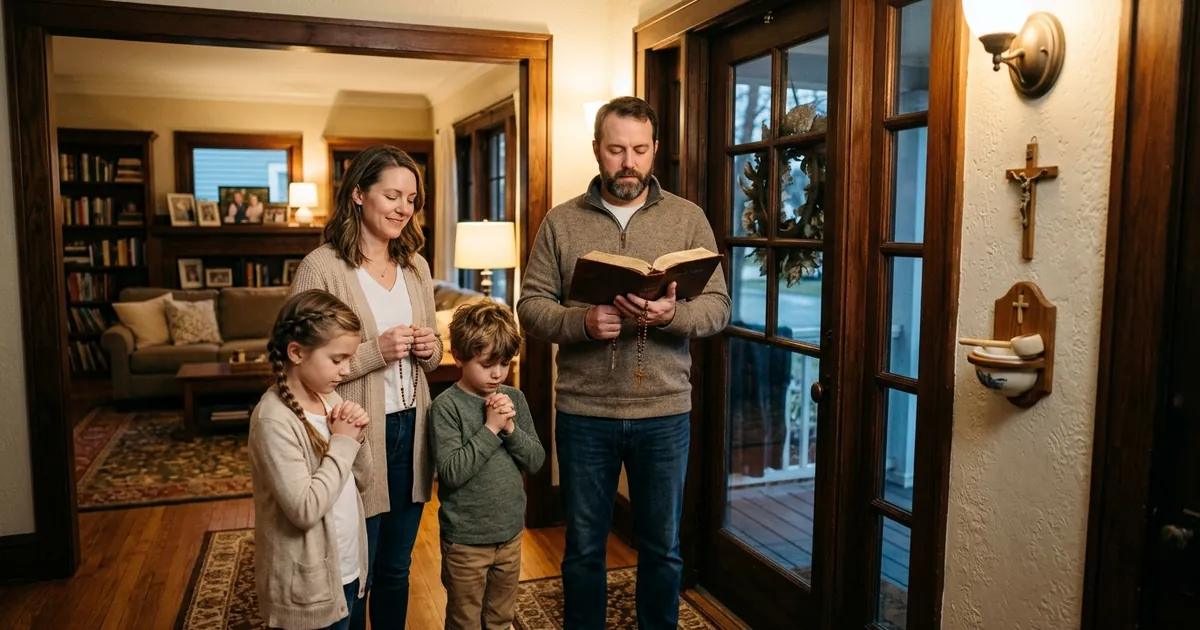
A Catholic family can pray for God's blessing over the home by making the Sign of the Cross, reading a short Scripture passage, asking for peace and charity, and—if desired—sprinkling holy water obtained from a parish. A priest or deacon can provide a formal house blessing using the Church's approved rite. Holy water is a sacramental sign, not a magic spray, and a family prayer does not perform an exorcism.
The most important preparation is not a special object. It is a home where people are safe, truthful, forgiving, and attentive to the needs of one another. If a house has a practical danger, abuse, carbon-monoxide risk, infestation, or serious mental-health concern, prayer should accompany qualified help rather than replace it.
A complete home-blessing prayer
> God our Father, we thank you for this home and for the people who live and visit here. Bless these rooms and make them places of peace, safety, honest work, rest, welcome, and prayer. Protect us from harm, teach us to protect one another, and help us repair what we have damaged. May Jesus Christ be at the center of this household, and may Saint Joseph teach us faithful care. In the name of the Father, and of the Son, and of the Holy Spirit. Amen.
What you may need
- a Bible or Gospel passage;
- a small crucifix or another respectful Christian image, if your family uses one;
- holy water from a parish, optional;
- a candle, used safely and never unattended;
- a list of people and situations for which you want to pray;
- the patience to keep the prayer simple.
Blessed salt is not necessary for a family prayer. If a parish provides a specific sacramental, ask how it is meant to be used. Do not buy “exorcised” objects from a seller who promises guaranteed protection or pressures you with fear.
Sacramentals are not magic
Sacramentals are sacred signs through which the Church prepares people to receive grace and sanctifies aspects of ordinary life. Their fruit depends on God's grace, the Church's prayer, and the faith and disposition of the people using them. They do not function like charms that force a spiritual result.
Holy water can remind a baptized person of Christ, repentance, and God's blessing. A crucifix can direct attention to the Cross. A medal can recall a saint's intercession. None of these objects replaces prayer, moral responsibility, medical care, a smoke alarm, a police call, or a priest's discernment.
A simple family blessing, step by step
1. Choose a peaceful time
Gather when people are not rushing. A Sunday, the arrival in a new home, the beginning of a school year, or the Epiphany season can be meaningful, but there is no magical date. Turn off unnecessary notifications and include children in a way they can understand.
2. Begin at the entrance
Stand together near the main entrance. Make the Sign of the Cross and say:
> In the name of the Father, and of the Son, and of the Holy Spirit. Amen.
Explain that the entrance is a reminder that everyone who comes in should be welcomed with truth, safety, and charity.
3. Read Scripture
Choose a short passage such as Psalm 127, Joshua 24:15, Luke 10:5, or John 14:23. Read slowly. The purpose is to hear God's Word, not to use a verse as an incantation.
4. Give thanks and name the needs
Thank God for the home, work, shelter, food, and people who live there. Pray for anyone who is sick, grieving, lonely, unemployed, or unsafe. If the household has conflict, ask for humility and practical reconciliation.
5. Sprinkle holy water, if you have it
A family may walk through the home and sprinkle a small amount of holy water while praying. This is a devotional practice, not the official rite of a priest. Avoid claiming that drops in four corners automatically remove evil or guarantee protection.
You may say:
> May this home be a place of peace, truth, rest, welcome, and service. May all who live here grow in love of God and one another. Amen.
6. Pray for each room
Keep the intention connected to the room's real purpose:
- Kitchen: gratitude for food and care for people who are hungry.
- Bedroom: rest, marital tenderness, privacy, and freedom from fear.
- Children's room: safety, growth, learning, and wise guidance.
- Work or study area: honesty, patience, and responsible work.
- Living area: hospitality, listening, forgiveness, and shared prayer.
7. Close with a Christian prayer
Pray the Lord's Prayer, a Psalm, or a short prayer to Saint Joseph. End with the Sign of the Cross. A family may repeat the practice whenever it helps renew attention to God, but frequency does not make the house more protected by a spiritual mechanism.
When to invite a priest or deacon
Ask your parish about a formal house blessing when you move, begin married life, establish a new household, or want the family to pray with a minister. A priest's or deacon's blessing belongs to the Church's liturgical and pastoral ministry. It is not more powerful because the home has a particular architectural feature or because an online seller recommends a product.
If there is a serious spiritual concern, speak with the parish priest. A layperson should not conduct an exorcism, diagnose possession, confront an alleged spirit, or instruct a family to stop medical or psychological care. Priests follow diocesan processes for extraordinary cases.
If the home feels frightening or unsafe
First check ordinary causes: carbon monoxide, electrical faults, gas, mold, sleep deprivation, medication effects, domestic violence, threats, or a person in crisis. Leave and call emergency services if there is immediate danger.
If someone hears voices, sees things others do not, cannot sleep, feels watched, or believes they have a unique supernatural mission, respond with compassion and arrange qualified mental-health care alongside pastoral support. A prayer can be offered without deciding the cause.
Saint Joseph and the domestic church
Saint Joseph protected and served the Holy Family in ordinary circumstances. The Gospels show him responding to danger with practical action: he takes Mary and Jesus to safety, works, and provides. Asking his intercession for a home should therefore lead to concrete protection, patient care, and responsible decisions.
The home is blessed not because a statue is placed at the door but because the people inside learn to receive God's grace and love one another. A Saint Joseph image can be a helpful reminder of that vocation.
Related prayers and guides
Anti-thin-content test
- Clear reason to exist: gives a safe, practical family prayer while explaining sacramentals and the boundary between blessing and exorcism.
- Practical usefulness: lists optional materials, gives room-by-room steps, prayer text, priest guidance, and safety checks.
- Distinctive depth: rejects magical thinking and integrates spiritual, household, medical, and safeguarding responsibility.
- Intent satisfied: a Catholic family can pray simply and know when to contact a parish or emergency service.