tool / instructional spiritual practice guide
Liturgy of the Hours: A Practical Guide for the Domestic Church
Learn how beginners can pray Lauds, Vespers, and Compline at home, choose a book or app, and build a sustainable Liturgy of the Hours routine.
Part of the Tools prayer collection.
In brief
The Liturgy of the Hours, also called the Divine Office, is the Church's public prayer through the Psalms, Scripture, intercessions, and prayers at different times of day. It is not reserved for priests and monks. Lay Catholics may pray it at home, alone, with children, or with a parish group.
Beginners do not need to start with every hour or master a four-volume breviary in one week. Start with one of the Church's hinge hours—Lauds in the morning or Vespers in the evening—and add Compline at night if it serves your routine. The goal is a stable rhythm of prayer, not a new source of guilt.
Saint Joseph and prayer in ordinary work
The Gospels do not give us a schedule of Joseph's private prayers. We can responsibly say that he lived within the Jewish world of Scripture, synagogue worship, household blessings, and prayer such as the Shema. It is a devotional inference—not a documented timetable—that Joseph's work and prayer belonged together.
That makes him a useful model for the layperson. A carpenter's workshop, a commute, a school day, and a family kitchen are not monasteries, but they can be interrupted by praise. Praying Lauds before work, Vespers after work, or Compline before bed places ordinary labor within a larger life of faith.
A short prayer before the Hours
> Lord Jesus, unite my prayer with the voice of your Church. Teach me to receive the Psalms honestly, to praise you in the morning, to give thanks in the evening, and to rest in your mercy at night. Bless my work and my family, and let this rhythm make me more attentive to love. Amen.
What the Hours are
The Hours sanctify time by placing the day before God. The Psalms give words for praise, sorrow, trust, repentance, and hope. Scripture readings keep the prayer connected to the Church's calendar. Intercessions widen the prayer beyond personal worries.
The official books and approved digital resources contain a cycle of psalms, antiphons, readings, hymns, and concluding prayers. The exact arrangement differs between the Roman Liturgy of the Hours, local calendars, religious communities, and other Catholic traditions. Use a source that belongs to the rite and country you are actually praying with.
The three-pillar plan
Pillar 1: Lauds, or Morning Prayer
Pray Lauds after waking or before the day's main work. It usually includes an opening, a hymn, psalmody, a short reading, a responsory, the Benedictus, intercessions, the Lord's Prayer, and a concluding prayer.
If the full hour is too long, begin by praying the psalmody and Benedictus slowly, then return to the complete form when ready. Offer the day to God and include the people you will meet.
Pillar 2: Vespers, or Evening Prayer
Vespers is a natural prayer after work or before dinner. It gives thanks for grace received, asks forgiveness for failures, and places the day's burdens before God. The Magnificat is the characteristic Gospel canticle.
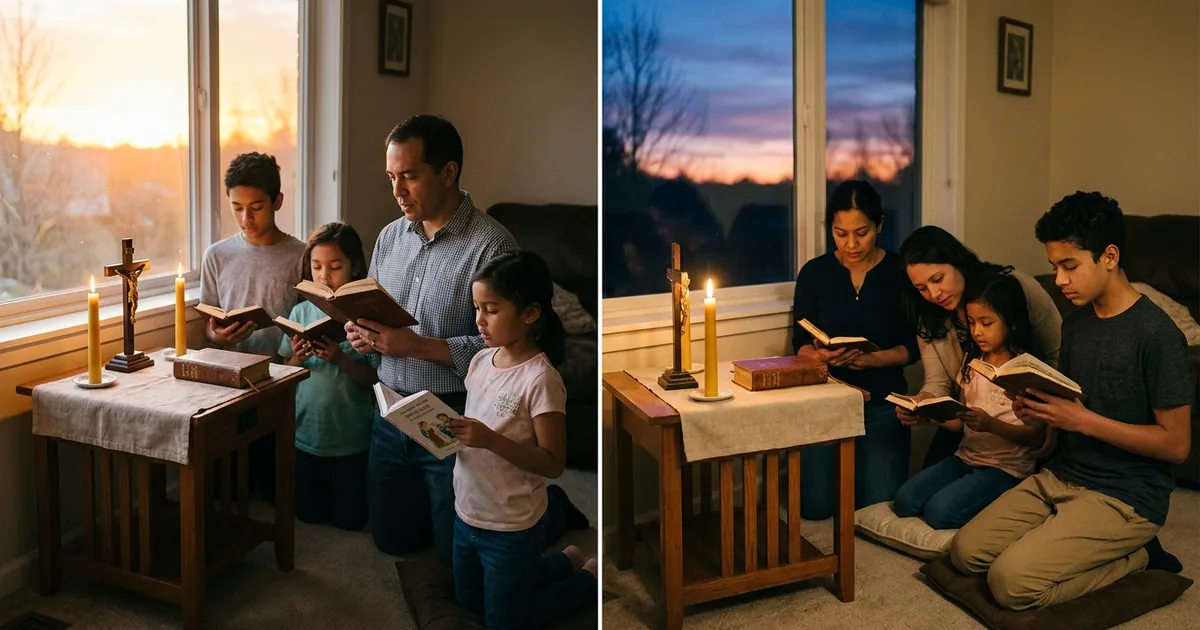
Families can begin with one psalm, the Magnificat, and the concluding prayer while children learn the rhythm. A shortened family introduction is not the same as claiming to have completed the full official hour; clarity prevents both discouragement and confusion.
Pillar 3: Compline, or Night Prayer
Compline is brief and calm. It includes an examination of conscience, a psalm or psalms, a short reading, the Nunc Dimittis, and a Marian antiphon or seasonal conclusion. It is a good place to end the day without trying to solve every problem before sleep.
If you miss Compline, simply pray at another time or begin again the next night. Laypeople are not under the same daily obligation as clergy and religious who are bound by their state of life. The Hours are a gift, not a test of spiritual worth.
A five-step beginner routine
- Choose one hour: begin with Lauds, Vespers, or Compline rather than all seven.
- Choose one reliable source: use an approved book or reputable app for your rite and calendar.
- Locate the day: confirm the date, season, feast, and week of the psalter before starting.
- Pray aloud or silently: follow the antiphons and responses; do not rush to finish.
- Return tomorrow: consistency matters more than one impressive session.
When using a printed book, learn the parts gradually: the ordinary gives the fixed structure; the psalter supplies the recurring psalms; the proper of seasons and saints supplies texts for the day. If ribbons are confusing, mark one hour and ask a parish or experienced friend for help.
Books and digital tools
- One-volume Christian Prayer: a practical entry point for people who want a book without managing the full four-volume set. Check which edition and calendar it follows.
- Four-volume Liturgy of the Hours: offers the fuller Roman cycle but requires learning the structure and handling seasonal and saint texts.
- iBreviary and similar apps: can reduce page-turning and automatically present texts for a date. Confirm that the app uses an approved translation and the correct local calendar.
- Audio or sung resources: useful for commuting or housework, but keep safety first and do not use a phone while driving in a distracting way.
Digital convenience should serve prayer, not turn prayer into endless notification checking. Silence alerts, download the day's text, and keep a printed fallback if the screen becomes a distraction.
Can a layperson pray the Hours?
Yes. Lay participation is encouraged, especially through Morning and Evening Prayer. The obligation to pray the full Office depends on a person's state in life and ecclesial assignment; most laypeople are not bound in the same way as priests and religious.
The Church's public prayer can be prayed privately. A family can also join a parish celebration or pray a shorter portion together. Do not compare your schedule with a monastery's schedule or treat a missed hour as a mortal sin.
Related prayers and guides
Anti-thin-content test
- Clear reason to exist: removes the practical barriers to praying the Hours without distorting the liturgy or reproducing its full copyrighted texts.
- Practical usefulness: provides a three-pillar plan, five steps, book/app guidance, family adaptation, and a prayer.
- Distinctive depth: connects ordinary work and Saint Joseph with a careful distinction between devotional inference and documented fact.
- Intent satisfied: a beginner can choose one hour and begin with a realistic routine.