post
The Glorious Mysteries: Meditations on Hope and Heaven
Pray the Glorious Mysteries with Scripture, traditional fruits, and compassionate reflections on the Resurrection, Heaven, Mary, grief, and Christian hope.
Part of the Rosary prayer collection.
In brief
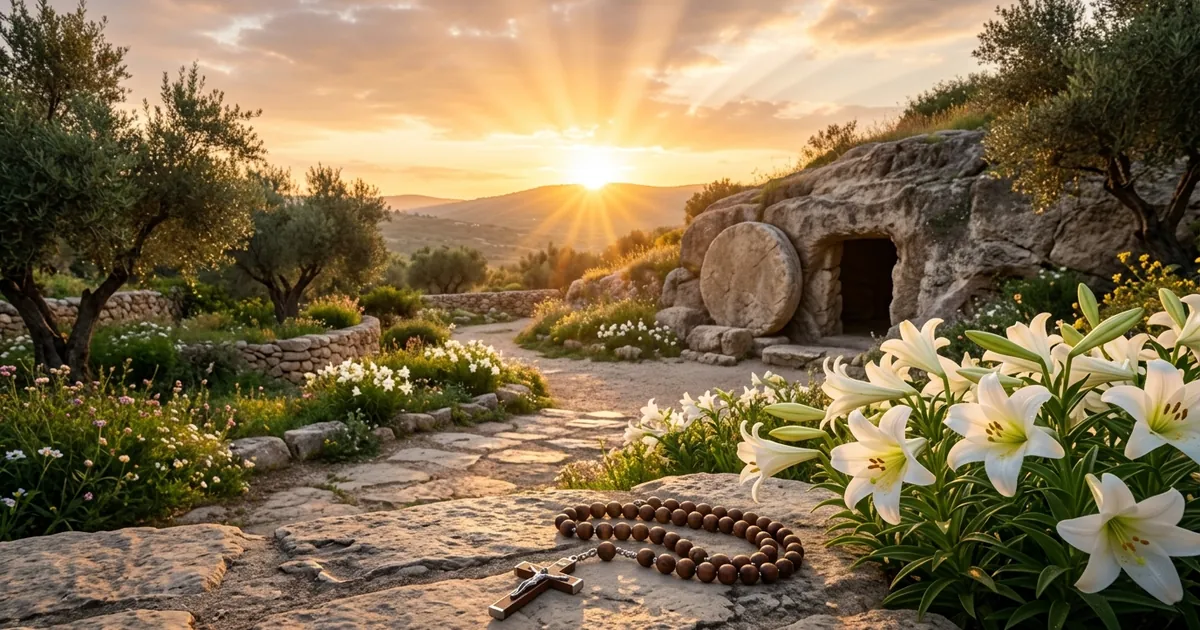
The five Glorious Mysteries are the Resurrection, Ascension, Descent of the Holy Spirit, Assumption of Mary, and Coronation of Mary. They contemplate Christ's victory, the Church's mission, and the hope of resurrection and communion with God. They are commonly prayed on Wednesday and Sunday.
Pray the full Rosary with these mysteries
Use this page as your prayer companion. The five mysteries and their Scripture references appear above; the complete order and common English prayer texts are kept here so you can pray without leaving the page.
- Begin with the Sign of the Cross and the Apostles' Creed on the crucifix.
- Pray one Our Father, three Hail Marys, and one Glory Be on the opening beads.
- For each of the five mysteries above: announce the mystery, read its Gospel citation, pray one Our Father, ten Hail Marys, one Glory Be, and the optional Fatima Prayer.
- Close with the Hail, Holy Queen and the concluding prayer.
Common Rosary prayer texts
The Apostles' Creed
I believe in God, the Father almighty, Creator of heaven and earth; and in Jesus Christ, His only Son, our Lord; who was conceived by the Holy Spirit, born of the Virgin Mary, suffered under Pontius Pilate, was crucified, died and was buried. He descended into hell; on the third day He rose again from the dead. He ascended into heaven, and is seated at the right hand of God the Father almighty; from there He will come to judge the living and the dead. I believe in the Holy Spirit, the Holy Catholic Church, the communion of saints, the forgiveness of sins, the resurrection of the body, and life everlasting. Amen.
The Our Father
Our Father, who art in heaven, hallowed be thy name; thy kingdom come; thy will be done on earth as it is in heaven. Give us this day our daily bread; and forgive us our trespasses, as we forgive those who trespass against us; and lead us not into temptation, but deliver us from evil. Amen.
The Hail Mary
Hail Mary, full of grace, the Lord is with thee; blessed art thou among women, and blessed is the fruit of thy womb, Jesus. Holy Mary, Mother of God, pray for us sinners, now and at the hour of our death. Amen.
The Glory Be
Glory be to the Father, and to the Son, and to the Holy Spirit: as it was in the beginning, is now, and ever shall be, world without end. Amen.
The Fatima Prayer (optional)
O my Jesus, forgive us our sins, save us from the fire of hell; lead all souls to heaven, especially those in most need of thy mercy. Amen.
The Hail, Holy Queen
Hail, holy Queen, Mother of mercy, our life, our sweetness and our hope. To thee do we cry, poor banished children of Eve; to thee do we send up our sighs, mourning and weeping in this valley of tears. Turn then, most gracious advocate, thine eyes of mercy toward us; and after this our exile show unto us the blessed fruit of thy womb, Jesus. O clement, O loving, O sweet Virgin Mary. Pray for us, O holy Mother of God, that we may be made worthy of the promises of Christ.
Concluding prayer
O God, whose Only Begotten Son, by His life, death and resurrection, has purchased for us the rewards of eternal life; grant, we beseech Thee, that meditating upon these mysteries of the Most Holy Rosary of the Blessed Virgin Mary, we may imitate what they contain and obtain what they promise, through the same Christ our Lord. Amen.
How to pray these mysteries
Use the step-by-step Rosary guide. Read the Scripture reference, name the mystery, ask for the traditional fruit if helpful, and let the meditation lead to faith, hope, and love expressed in a concrete way.
1. The Resurrection
Scripture: Matthew 28:1-10; Mark 16:1-8; Luke 24:1-12; John 20:1-18
Mystery: Jesus rises from the dead.
Traditional fruit: Faith and conversion.
Meditation: The Resurrection is not merely a metaphor for feeling better. It is the center of Christian proclamation: God raises Christ bodily and opens a hope stronger than death. Bring one area of discouragement to prayer, then ask what faithful action can begin again.
Prayer: Risen Lord, strengthen my faith when hope feels impossible. Help me begin again without denying what has been lost. Amen.
2. The Ascension
Scripture: Acts 1:6-12; Luke 24:50-53
Mystery: The risen Jesus ascends to the Father.
Traditional fruit: Hope and desire for heaven.
Meditation: The Ascension does not mean Christ abandons the world. It directs the Church to live its mission in the present while expecting the fulfillment of God's kingdom. Hope looks upward without escaping responsibilities on earth.
Prayer: Lord Jesus, raise my attention toward your promise and send me back to my duties with courage, patience, and love. Amen.
3. The Descent of the Holy Spirit
Scripture: Acts 2:1-13
Mystery: The Holy Spirit comes upon Mary and the disciples at Pentecost.
Traditional fruit: Love of God and zeal for mission.
Meditation: The Spirit creates a community that speaks across difference and serves publicly. Ask for courage to use your gifts for the common good, not only for private comfort or recognition.
Prayer: Holy Spirit, give the Church wisdom, unity, courage, and compassion. Show me one way to serve rather than remain a spectator. Amen.
4. The Assumption of Mary
Scripture and tradition: Luke 1:46-55; Catholic teaching on Mary's Assumption.
Mystery: Mary is taken body and soul into heavenly glory at the end of her earthly life.
Traditional fruit: Grace of a good death and hope in resurrection.
Meditation: The Assumption affirms the dignity of the human body and the hope that God's promise includes the whole person. It does not deny illness, aging, or grief. It asks Christians to treat bodies with care and to hope for the resurrection of the dead.
Prayer: Mary, accompany those who are sick, dying, or grieving. Help us respect the body, care for the vulnerable, and trust God's promise of life. Amen.
5. The Coronation of Mary
Scripture and tradition: Revelation 12:1; Catholic Marian tradition.
Mystery: Mary is honored as Queen in the glory of heaven.
Traditional fruit: Perseverance and growth in holiness.
Meditation: Marian honor points beyond Mary to God's grace. The crown is not a worldly reward for status; it is a sign of the dignity and service of one who magnifies the Lord. Let the mystery lead to humility and charity, not comparison.
Prayer: Lord, help me persevere in quiet faithfulness and honor the dignity of every person. May hope make me more loving, not less attentive to suffering. Amen.
Hope, grief, and the resurrection of the body
Christian hope is not the claim that death is unreal or that memories alone keep a person alive. It is trust in God's promise of resurrection and communion. A grieving person can believe in hope and still feel anger, emptiness, confusion, or exhaustion.
Pray gently. Speak the person's name, ask for support, and allow grief to take time. If grief is overwhelming or makes ordinary life impossible for a prolonged period, seek a priest, grief counselor, doctor, or mental-health professional.
A note about Saint Joseph in heavenly glory
Some Catholic writers and devotional traditions have speculated that Saint Joseph may have been taken into heavenly glory in a special way. The Church has not defined this as a universal doctrine. It is safer to present it as a pious opinion, not as a fact required for Catholic belief.
The Glorious Mysteries can be connected with Saint Joseph through hope, faithful service, and care for the dying, without inventing a definitive account of his death or resurrection.
When are the Glorious Mysteries prayed?
They are commonly prayed on Wednesday and Sunday. You may choose them on another day for a feast, a community prayer, or a personal need. See the weekly Mysteries schedule.
Sources & Tradition
Frequently asked questions
What are the five Glorious Mysteries?
They are the Resurrection, Ascension, Descent of the Holy Spirit, Assumption of Mary, and Coronation of Mary.
What are the fruits of the Glorious Mysteries?
Traditional prayer books associate them with faith, hope, love of God, desire for heaven, a good death, perseverance, and growth in holiness. The lists vary and are prompts for prayer rather than a fixed formula.
What days are the Glorious Mysteries prayed?
They are commonly prayed on Wednesday and Sunday. Local communities may use another schedule.
What do the Glorious Mysteries teach about death?
They teach Christian hope in Christ's Resurrection and the resurrection of the dead. They do not deny grief or promise that death will be painless; they place death within the hope of God's mercy and final restoration.
Is Saint Joseph's bodily assumption Catholic doctrine?
No. Some devotional writers have held that opinion, but the Church has not defined it as a required belief. The page should not present it as settled doctrine.