post
The Mysteries of the Rosary: Schedule and Guide
See which Rosary mysteries are prayed each day, with the Joyful, Sorrowful, Glorious, and Luminous sets explained and linked for meditation.
Part of the Rosary prayer collection.
In brief
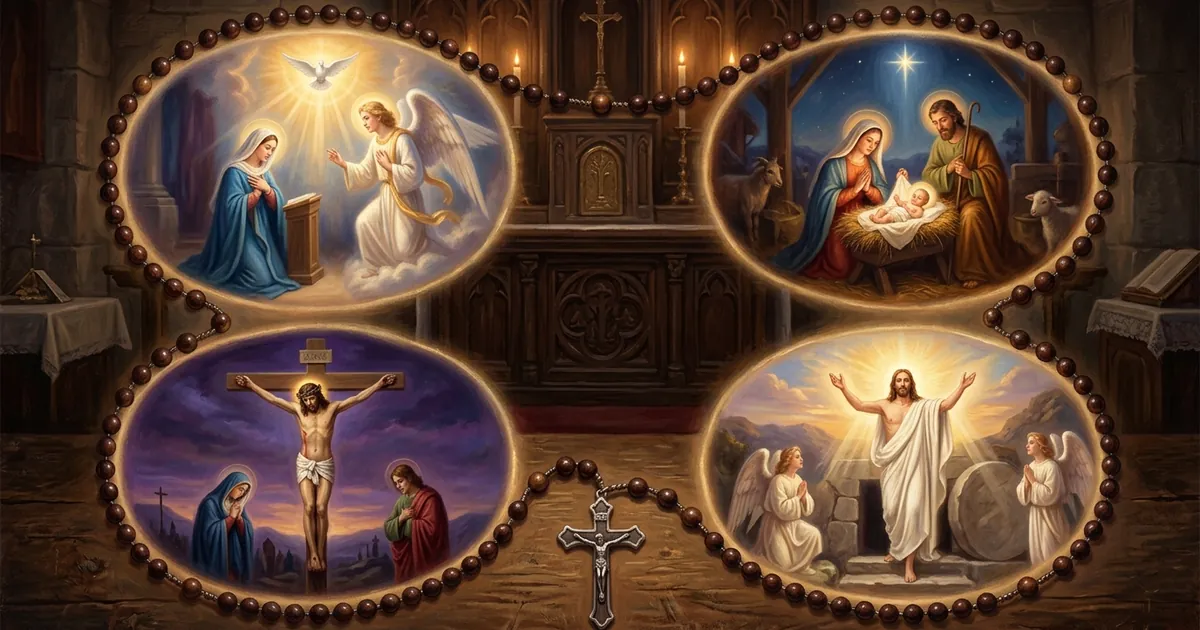
The common Catholic Rosary schedule is: Joyful Mysteries on Monday and Saturday, Sorrowful Mysteries on Tuesday and Friday, Glorious Mysteries on Wednesday and Sunday, and Luminous Mysteries on Thursday. If today is Thursday, for example, pray the Luminous Mysteries.
Weekly Rosary mysteries schedule
| Day | Mysteries commonly prayed | Focus |
| --- | --- | --- |
| Monday | Joyful | The Incarnation and Jesus' hidden years |
| Tuesday | Sorrowful | Christ's Passion and death |
| Wednesday | Glorious | Resurrection, Ascension, and the Church's hope |
| Thursday | Luminous | Jesus' public ministry and the Eucharist |
| Friday | Sorrowful | Christ's Passion and the cost of love |
| Saturday | Joyful | Mary, the Incarnation, and family life |
| Sunday | Glorious | The Resurrection and the mystery of salvation |
This is the widely used schedule associated with the modern four-set Rosary. A parish, family, or retreat may choose another arrangement.
The four sets of mysteries
Joyful Mysteries
The Joyful Mysteries contemplate the Annunciation, Visitation, Nativity, Presentation in the Temple, and Finding of Jesus in the Temple. They attend to God's presence in family life, hidden years, obedience, joy, and searching.
Sorrowful Mysteries
The Sorrowful Mysteries contemplate the Agony in the Garden, Scourging, Crowning with Thorns, Carrying of the Cross, and Crucifixion. They invite prayer with Christ's suffering and with people who suffer, without glorifying abuse or treating pain as automatically good.
Glorious Mysteries
The Glorious Mysteries contemplate the Resurrection, Ascension, Descent of the Holy Spirit, Assumption of Mary, and Coronation of Mary. They turn attention toward life, hope, the Church, and the fulfillment of God's promises.
Luminous Mysteries
The Luminous Mysteries contemplate Jesus' Baptism in the Jordan, the Wedding at Cana, the Proclamation of the Kingdom, the Transfiguration, and the Institution of the Eucharist. They focus on the light of Christ's public ministry.
How to use this page while praying
- Find the day of the week in the table.
- Open the linked set and read the five mystery titles.
- Choose one Gospel verse or meditation for each decade.
- Follow the step-by-step Rosary guide.
You do not need to memorize every meditation before beginning. The purpose is to pray with the Gospel, not to pass a test.
What if I pray a different set?
You may choose another set when a feast, community prayer, personal need, or local custom calls for it. The schedule is a helpful rhythm, not a rule that makes a prayer invalid on another day.
Sources & Tradition
Frequently asked questions
Which Rosary mysteries are prayed on Monday?
The Joyful Mysteries are commonly prayed on Monday. They include the Annunciation, Visitation, Nativity, Presentation, and Finding of Jesus in the Temple.
Which mysteries are prayed on Tuesday?
The Sorrowful Mysteries are commonly prayed on Tuesday. They lead through Jesus' Passion and death.
What mysteries are prayed on Thursday?
The Luminous Mysteries are commonly prayed on Thursday. They focus on events in Jesus' public ministry and the Eucharist.
Why are there four sets of Rosary mysteries?
The traditional Joyful, Sorrowful, and Glorious sets were joined by the Luminous Mysteries, proposed by Saint John Paul II in 2002. Together they provide a broad meditation on Christ's life and saving work.
Do I have to follow the weekly schedule?
No. The schedule is a common tradition that helps people pray together. A different set may be chosen for a feast, parish custom, retreat, or personal reason.